In today’s digital era, data is often seen as an objective foundation for decision-making. Governments rely on data to design policies, allocate resources, and evaluate outcomes. From social welfare distribution to urban planning and healthcare systems, data has become the backbone of modern governance.
However, the assumption that data is neutral is deeply misleading.
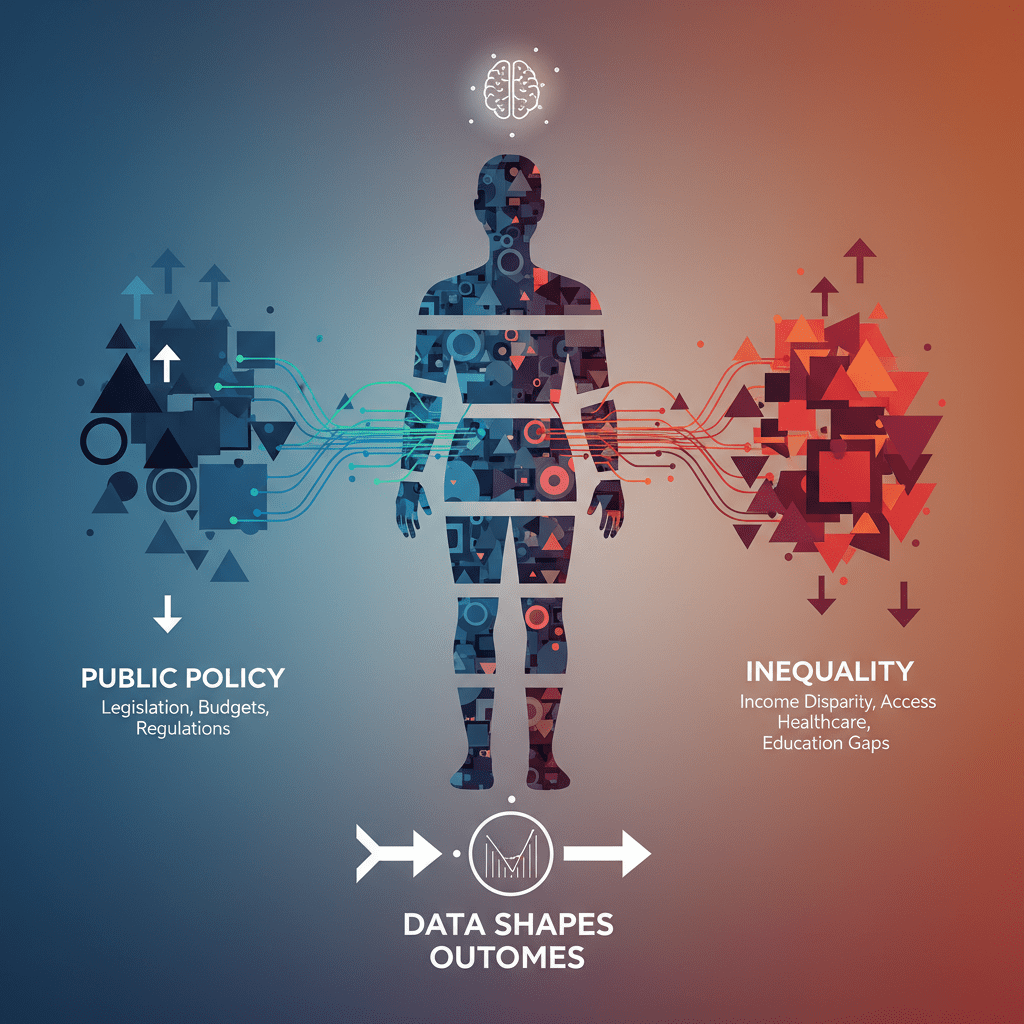
Data does not simply reflect reality it actively shapes it. The way data is collected, processed, and interpreted can reinforce existing inequalities or, alternatively, help reduce them. Understanding this dual role is essential to unpacking how public policy operates in a data-driven world.
Data as the Foundation of Policy
Public policy today is increasingly data-driven. Governments use datasets to identify problems, target beneficiaries, and monitor program effectiveness. For example, poverty alleviation programs rely on socioeconomic data to determine who qualifies for assistance. Similarly, predictive analytics is used in areas such as public health, taxation, and even law enforcement.
At first glance, this seems efficient and rational. Data enables governments to move beyond intuition and toward evidence based policymaking.
But this efficiency comes with risks.
Data is never complete, and it is rarely unbiased. Every dataset is shaped by decisions: what to measure, how to measure it, and whose data is included or excluded. These decisions are not purely technical, they are political.
The Hidden Bias in Data Systems
Bias in data can emerge at multiple stages.
First, there is collection bias. Not all populations are equally represented in datasets. Marginalized communities are often undercounted or misrepresented, whether due to lack of access, informal status, or systemic exclusion. When these groups are invisible in data, they are also invisible in policy.
Second, there is processing bias. Algorithms and analytical models are built on assumptions that may not hold across different social contexts. For instance, credit scoring systems or welfare eligibility models may unintentionally penalize those with irregular income or non-traditional livelihoods.
Third, there is interpretation bias. Policymakers interpret data through institutional and political lenses. The same dataset can lead to different conclusions depending on priorities, incentives, and power structures.
As a result, policies built on biased data can reproduce inequality rather than address it.
When Data Reinforces Inequality
There are many examples where data-driven policies have unintentionally deepened social divides.
In social protection systems, inaccurate or outdated data can lead to exclusion errors where those who need assistance the most are left out. In contrast, inclusion errors can result in resources being allocated to those who are less in need, undermining public trust.
In the realm of digital governance, algorithmic decision-making can amplify bias at scale. For example, automated systems used for hiring, policing, or loan approvals may reflect historical inequalities embedded in training data.
Even in urban development, data-driven planning can prioritize areas with better data availability often wealthier neighborhoods, while neglecting informal or underserved regions.
These examples illustrate a crucial point: data does not merely inform policy it shapes who benefits and who is left behind.
The Data–Justice Nexus
To address these challenges, we need to move beyond viewing data as a purely technical tool. Instead, we must understand it as part of a broader relationship between data, power, and justice, what can be described as the Data–Justice Nexus.
This perspective highlights three key dimensions:
- Representation: Who is visible in the data? Whose experiences are captured, and whose are ignored?
- Distribution: How are resources and opportunities allocated based on data-driven decisions?
- Governance: Who controls data systems, and who is accountable for their outcomes?
By examining these dimensions, we can better understand how data influences inequality and identify pathways for more just policymaking.
Toward More Just Data-Driven Policies
Recognizing the limitations of data is the first step toward improving it. Governments and institutions need to adopt more inclusive and reflexive approaches to data governance.
This includes:
- Improving data collection to better represent marginalized groups
- Auditing algorithms and models for bias and unintended consequences
- Increasing transparency in how data is used in decision-making
- Engaging communities in the design and evaluation of data systems
Ultimately, the goal is not to abandon data-driven policymaking, but to make it more equitable.
Conclusion
Data has the power to transform public policy but it also has the power to entrench inequality.
Treating data as neutral obscures the ways in which it reflects and reproduces existing power structures. To build more just societies, we must critically examine how data is produced, governed, and applied.
Understanding how data shapes public policy is not just a technical issue it is a question of justice.
And in an increasingly data-driven world, that question is more urgent than ever.
 samivan.id