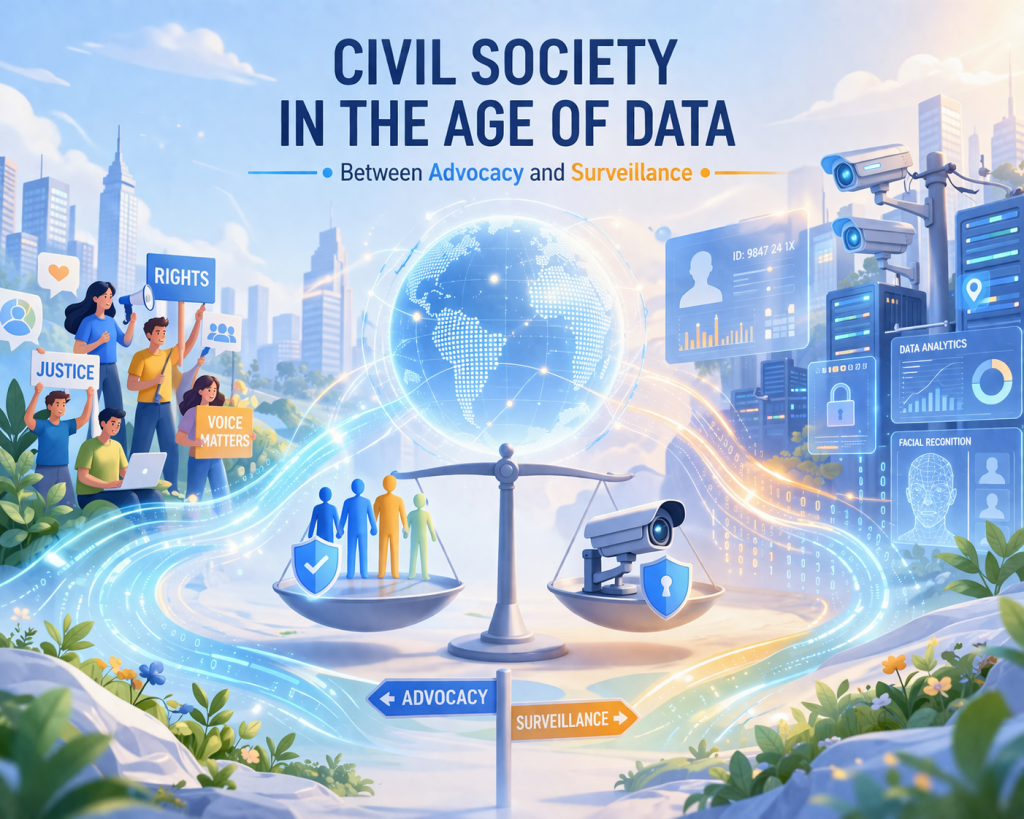
Civil society has long been understood as a cornerstone of democratic life. It represents the space where citizens organize, advocate, and hold power to account. Yet in an increasingly data-driven world, the role of civil society is being reshaped by new forms of digital power.
Today, civil society operates in an environment defined by data extraction, algorithmic systems, and platform governance. While these developments open new opportunities for advocacy, they also introduce new risks—particularly in the form of surveillance, dependency, and structural inequality.
From Advocacy to Data-Driven Action
In recent years, civil society organizations have increasingly relied on data to strengthen their advocacy efforts. From monitoring public spending to tracking environmental changes and documenting human rights violations, data has become a critical tool for influence.
The rise of open data initiatives and digital platforms has enabled organizations to produce evidence-based narratives and reach wider audiences. Campaigns are now supported by data visualization, real-time reporting, and digital mobilization strategies.
For example, civil society groups across different regions have used satellite data and crowdsourced information to monitor deforestation, disaster response, and electoral processes. These developments signal a shift from traditional advocacy to data-driven activism.
However, access to these capabilities remains uneven. Many grassroots organizations lack the technical capacity, infrastructure, or funding to fully leverage data. This creates new hierarchies within civil society itself (Taylor & Broeders, 2015).
The Expansion of Surveillance
At the same time, the digital environment in which civil society operates is increasingly shaped by surveillance.
Governments and private actors now have unprecedented capacities to collect and analyze data. Digital traces—ranging from social media activity to location data—can be used to monitor individuals and organizations. In some contexts, this has led to the targeting of activists, journalists, and advocacy groups.
Recent global trends show the growing use of digital surveillance tools, including spyware, biometric systems, and large-scale data monitoring infrastructures. Cases involving the deployment of advanced spyware technologies against civil society actors have raised serious concerns about privacy and freedom of expression (Amnesty International, 2023).
This creates a fundamental tension: the same digital tools that enable mobilization can also be used to suppress it.
Platform Dependency and Algorithmic Visibility
Civil society today is deeply embedded within digital platforms. Social media, search engines, and online infrastructures serve as key channels for communication, outreach, and mobilization.
Yet these platforms are not neutral spaces.
Algorithmic systems determine what content is visible, who gets amplified, and which narratives gain traction. Civil society organizations must navigate opaque rules, changing algorithms, and content moderation systems that they do not control.
This dependency raises important questions about autonomy and influence. If visibility is governed by platform logic, civil society’s ability to shape public discourse becomes contingent on systems designed primarily for commercial objectives (Gillespie, 2018).
Data Asymmetry and Structural Inequality
A critical issue in this landscape is data asymmetry—the unequal distribution of data access and analytical capacity.
Large technology companies and state institutions possess vast datasets and advanced computational resources. In contrast, many civil society actors operate with limited data and constrained analytical tools.
This imbalance affects not only advocacy but also accountability. Without access to relevant data, civil society struggles to challenge decisions, verify claims, or propose alternatives.
Moreover, issues that are easily quantifiable tend to dominate policy discussions, while more complex or less visible problems risk being marginalized (Kitchin, 2014).
Civil Society and the Data–Justice Nexus
These dynamics highlight the need to understand civil society within the broader Data–Justice Nexus.
- Representation: Which communities are visible in the data used for advocacy?
- Distribution: Who benefits from data-driven interventions and visibility?
- Governance: Who controls the infrastructures and rules that shape data use?
Civil society plays a crucial role in addressing these questions. However, its effectiveness depends on its ability to navigate and challenge the structures of data power.
Emerging Responses and New Directions
Despite these challenges, civil society is not passive. New approaches are emerging:
- Development of data literacy initiatives within communities
- Creation of alternative data infrastructures, including community data projects
- Advocacy for digital rights and data protection frameworks
- Collaboration with technologists to build ethical and accountable systems
Global movements around data justice and digital rights are increasingly recognizing the importance of civil society in shaping more equitable data ecosystems.
Conclusion
Civil society remains a vital force for justice, but its role is being transformed by the dynamics of data and digital power.
It is no longer enough to advocate within existing systems. Civil society must also engage with the infrastructures, algorithms, and governance models that shape those systems.
In the age of data, the question is not only how civil society speaks truth to power—but how it navigates, resists, and reshapes the very architectures of power itself.
References
- Amnesty International. (2023). Surveillance and Digital Rights Report.
- Taylor, L., & Broeders, D. (2015). In the Name of Development: Power, Profit and the Datafication of the Global South.
- Kitchin, R. (2014). The Data Revolution: Big Data, Open Data, Data Infrastructures and Their Consequences.
- Gillespie, T. (2018). Custodians of the Internet: Platforms, Content Moderation, and the Hidden Decisions That Shape Social Media.
 samivan.id
Leave a comment