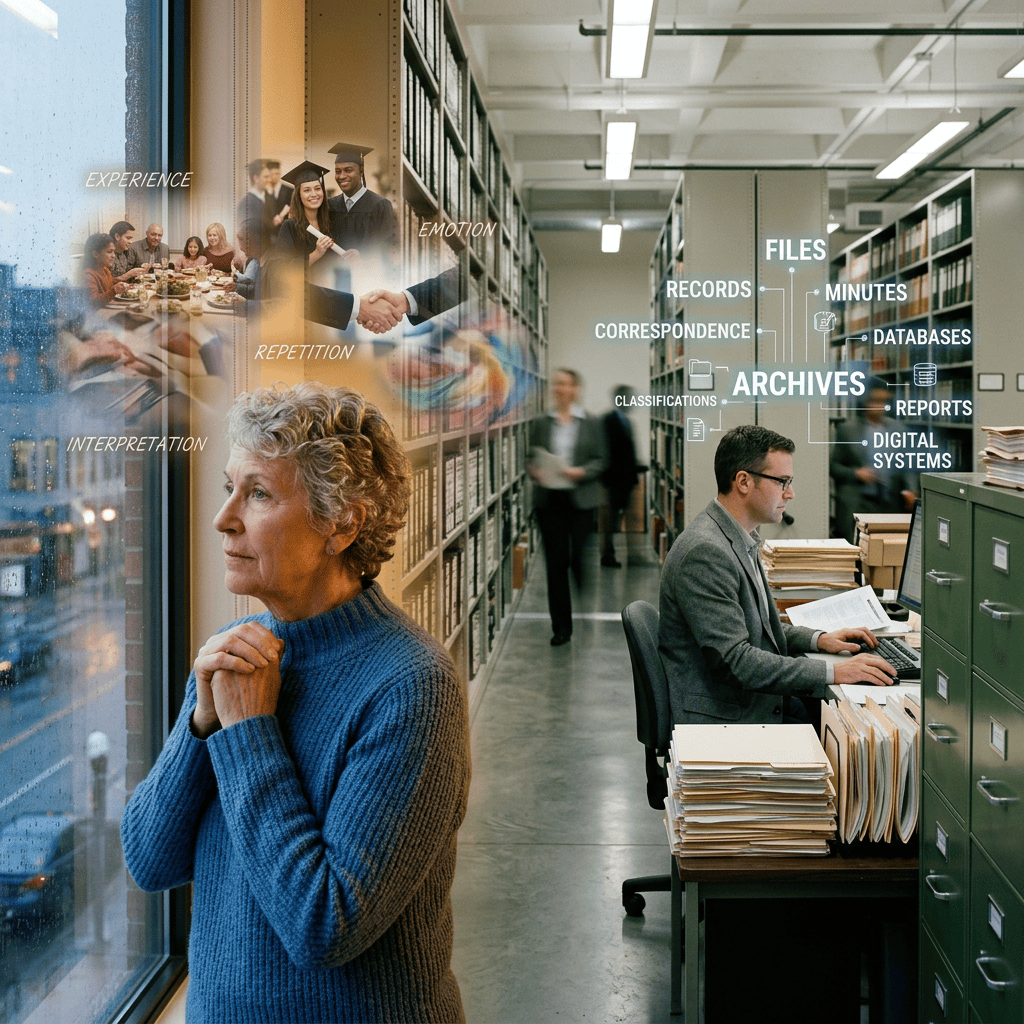
Institutions remember in ways that individuals do not.
A person remembers through experience, emotion, repetition, and interpretation. Institutions remember through files, records, minutes, correspondence, databases, archives, classifications, reports, and increasingly, digital systems.
This distinction matters because institutional continuity depends heavily on what can be preserved beyond the people who temporarily occupy positions within an organization. Officials change. Employees retire. Leadership rotates. Teams are reorganized. Priorities shift. Yet institutions are expected to retain knowledge across these transitions.
Data makes that continuity possible.
A record created today may influence a decision years later. A classification entered into a database can become the starting point for future administrative action. A previous case can establish a pattern. Historical transaction data can shape risk assessments. Old reports can become evidence for evaluating new policies.
Institutions therefore do not merely store data.
They build memory through it.
But institutional memory is never a perfect reflection of the past. It depends on what was recorded, how it was categorized, what was preserved, what was lost, and what later systems are still capable of reading.
The question is not simply whether institutions remember.
It is what they are capable of remembering, and what their systems quietly allow them to forget.
Memory Beyond Individuals
Every institution faces a basic problem of continuity.
People leave.
Knowledge leaves with them.
An experienced employee may understand why a particular procedure evolved. A senior official may remember the political context behind an earlier policy. A local administrator may know that a particular case was exceptional even though the official documentation makes it appear routine.
Much of this knowledge exists informally.
It lives in conversations, experience, professional intuition, and relationships.
Institutions attempt to reduce dependence on individual memory by converting knowledge into records.
This is one of the fundamental functions of bureaucracy.
Max Weber’s analysis of modern bureaucracy emphasized the importance of written documents, files, rules, and administrative continuity. Bureaucratic organizations depend upon records precisely because authority must survive beyond particular individuals.
The file allows the institution to remember when the employee no longer does.
Digitalization expands this capacity dramatically.
Records that once occupied physical archives can now be searched in seconds. Data can be replicated, linked, analyzed, and retrieved across multiple systems. Historical information can be integrated into operational decision-making.
Institutional memory becomes faster.
More searchable.
More scalable.
But greater storage capacity does not automatically produce better memory.
An institution can store almost everything and still fail to understand its own past.
The Difference Between Storage and Memory
Storage is not the same as memory.
A database may contain millions of records.
That does not mean the institution knows

