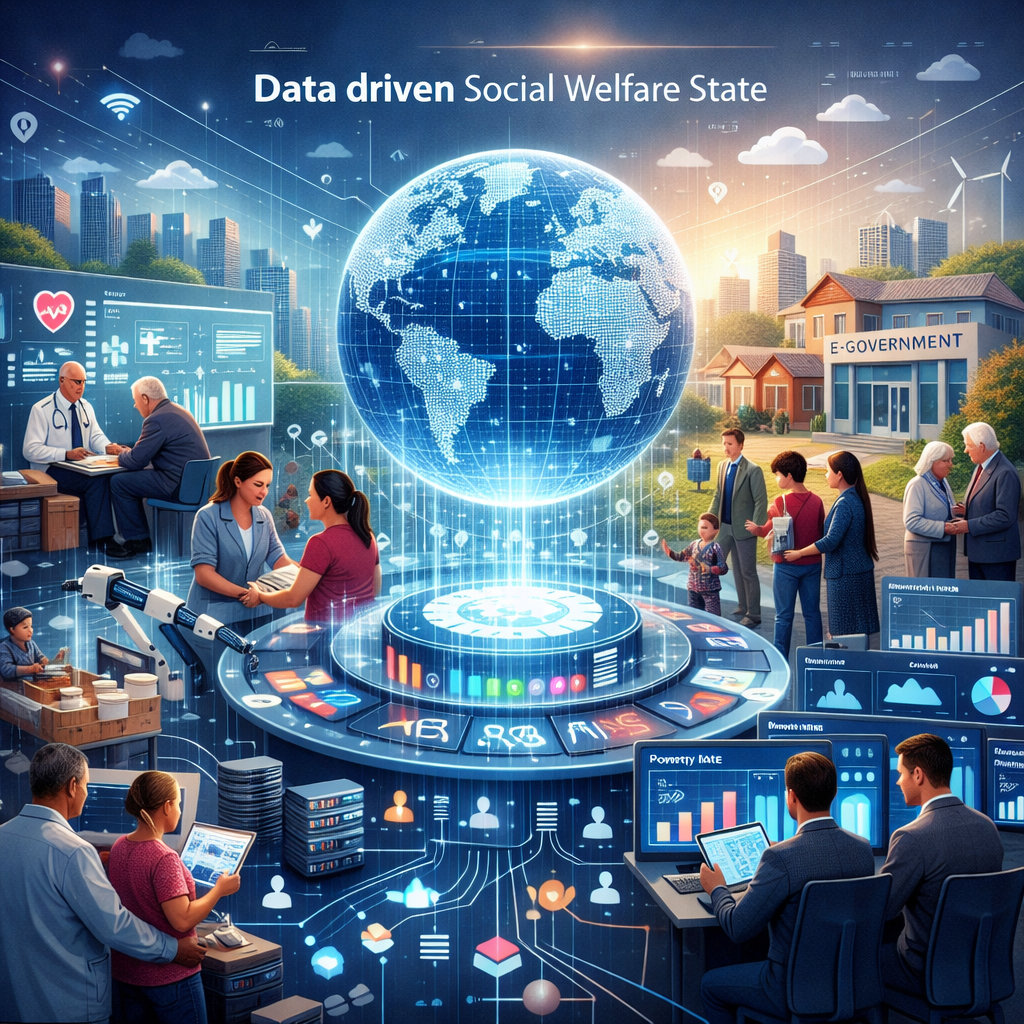
Rethinking Social Welfare in a Data Driven State
Social welfare systems have long been central to the role of the modern state. They are designed to reduce inequality, protect vulnerable populations, and ensure a basic standard of living. In recent years, however, the governance of social welfare has been increasingly shaped by data driven systems. From beneficiary identification to resource allocation, decisions are now informed by datasets, algorithms, and digital infrastructures.
This transformation raises a fundamental question. Can data driven welfare systems deliver greater fairness and efficiency, or do they risk reproducing and deepening existing inequalities?
From Universalism to Targeted Welfare
Historically, many welfare systems were built on principles of universal provision or broad eligibility. Over time, fiscal constraints and policy reforms have shifted the focus toward targeted welfare, where benefits are directed to specific groups deemed most in need.
Data plays a crucial role in this shift. Governments rely on socioeconomic databases, administrative records, and predictive models to determine eligibility. In theory, this allows for more precise targeting and efficient use of resources.
However, targeting also introduces new complexities. Determining who qualifies for assistance depends on how need is defined and measured. These definitions are embedded in data systems, which are shaped by assumptions, categories, and thresholds.
As a result, welfare systems become not only instruments of redistribution, but also systems of classification.
The Problem of Exclusion and Inclusion Errors
A central challenge in data driven welfare is the presence of exclusion and inclusion errors.
Exclusion errors occur when individuals who are eligible for assistance are left out of the system. This can happen due to incomplete or outdated data, lack of documentation, or barriers in accessing registration systems. In many contexts, the most vulnerable populations such as informal workers, migrants, or those in remote areas are the most likely to be excluded.
Inclusion errors, on the other hand, occur when benefits are allocated to individuals who do not meet the criteria. While often framed as inefficiency, these errors can also reflect deeper issues in how data captures social and economic realities.
Research on social protection systems shows that targeting mechanisms often struggle to accurately identify poverty, particularly in dynamic and informal economies (Hanna and Olken, 2018). This highlights the limitations of relying on static data to address complex social conditions.
Data Infrastructures and Administrative Power
Data driven welfare systems rely on large scale data infrastructures. These include integrated databases, digital identification systems, and platforms for service delivery.
While these infrastructures can improve coordination and monitoring, they also expand administrative power. The ability to collect, store, and analyze data gives institutions greater control over how welfare is distributed and managed.
This raises important concerns about transparency and accountability. Decisions that affect access to basic needs may be shaped by systems that are difficult to understand or challenge. Beneficiaries may not know why they were included or excluded, nor how to appeal decisions.
Scholars have pointed out that data infrastructures are not neutral tools, but socio technical systems that reflect institutional priorities and power relations (Kitchin, 2014).
Surveillance and Conditionality
Another dimension of data driven welfare is the expansion of monitoring and conditionality.
Digital systems enable governments to track compliance with program requirements, monitor behavior, and verify eligibility in real time. While this can reduce fraud and improve program integrity, it also introduces forms of surveillance into welfare systems.
Beneficiaries may be required to provide detailed personal information, submit to verification processes, or meet behavioral conditions. This can create a dynamic where access to support is tied to visibility and compliance.
In some cases, welfare systems risk becoming mechanisms of control rather than support. This tension between assistance and surveillance has been widely discussed in studies of digital governance and social policy (Eubanks, 2018).
Inequality in a Data Driven Welfare State
Data driven welfare systems do not operate in a vacuum. They are embedded in broader social and economic contexts characterized by inequality.
Access to digital systems, data literacy, and administrative processes is unevenly distributed. Those who are already marginalized may face additional barriers in navigating data driven systems. At the same time, individuals and groups with greater resources are often better positioned to understand and navigate eligibility criteria.
This creates the risk of reinforcing existing inequalities. Welfare systems designed to reduce inequality may inadvertently reproduce it if the underlying data and processes are not inclusive.
The Data Justice Perspective
Understanding these challenges requires a shift toward a data justice perspective.
First, representation matters. Who is included in welfare data, and how are their circumstances captured? Incomplete or biased data can lead to systematic exclusion.
Second, distribution matters. How are benefits allocated, and who ultimately gains or loses from data driven decisions?
Third, governance matters. Who controls welfare data systems, and what mechanisms exist for accountability and redress?
These dimensions highlight that social welfare is not only a question of policy design, but also of data governance.
Toward More Equitable Welfare Systems
Rethinking social welfare in a data driven state requires both technical and institutional changes.
Improving data quality and inclusiveness is essential, but not sufficient. There is also a need for transparency in how decisions are made, including clear explanations of eligibility criteria and decision processes.
Mechanisms for appeal and redress should be strengthened to ensure that individuals can challenge decisions that affect them. Human oversight must remain central, particularly in cases where automated systems are used.
Finally, policymakers should consider the limits of targeting and explore hybrid approaches that combine data driven methods with broader forms of social protection.
Conclusion
Data driven systems have the potential to transform social welfare, making it more efficient and responsive. However, they also introduce new risks related to exclusion, surveillance, and inequality.
Rethinking social welfare in the age of data requires recognizing that data is not neutral. It shapes how need is defined, how resources are distributed, and how power is exercised.
Ensuring that welfare systems remain just and inclusive depends not only on better data, but on a deeper commitment to equity, accountability, and human dignity.
References
Hanna, R., and Olken, B. (2018). Universal Basic Incomes versus Targeted Transfers. Journal of Economic Perspectives.
Kitchin, R. (2014). The Data Revolution. Sage.
Eubanks, V. (2018). Automating Inequality. St. Martin’s Press.


Leave a Reply