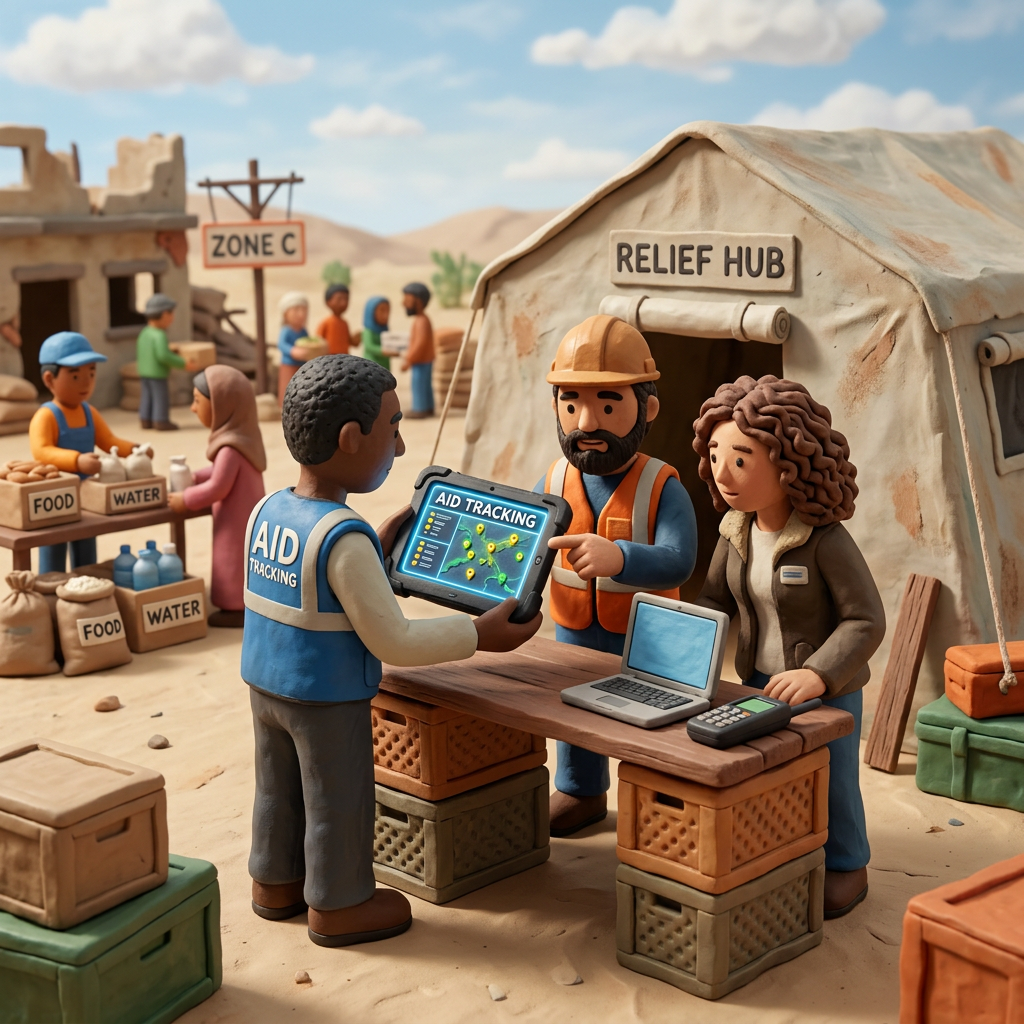
Humanitarian action has always been shaped by urgency, scarcity, and the moral imperative to save lives. In recent years, however, it has also become increasingly shaped by data. From crisis mapping and biometric registration to predictive analytics and digital cash transfers, data driven systems are transforming how humanitarian actors operate.
These developments promise greater efficiency, improved targeting, and more responsive interventions. Yet they also raise critical questions about power, inequality, and ethics. In a data driven world, humanitarian action must be rethought not only in terms of effectiveness, but also in terms of justice.
The Rise of Data Driven Humanitarianism
Humanitarian organizations now operate in an environment saturated with data. Satellite imagery, mobile phone data, social media, and administrative records provide new sources of information about crises and affected populations.
These data sources enable faster assessments and more informed decision making. Crisis mapping platforms allow responders to visualize needs in near real time. Digital identification systems support the delivery of aid. Predictive models are used to anticipate food insecurity, displacement, and disease outbreaks.
International organizations such as World Food Programme and United Nations High Commissioner for Refugees have integrated data systems into their operations, reflecting a broader shift toward data driven humanitarianism.
As Meier (2015) notes, the use of digital technologies in crisis response has expanded the capacity of humanitarian actors to collect and analyze information at scale.
Efficiency and Its Limits
Data driven systems are often justified in terms of efficiency. They can reduce duplication, improve coordination, and enable more precise targeting of aid. In contexts where resources are limited and needs are urgent, these benefits are significant.
However, efficiency is not the only goal of humanitarian action. It must also address equity and dignity.
Targeting systems, for example, rely on data to determine who qualifies for assistance. While this can improve resource allocation, it also introduces the risk of exclusion. Individuals who are not captured in data systems may be left without support.
Research has shown that data driven targeting in humanitarian contexts can struggle to capture the complexity of vulnerability, particularly in rapidly changing environments (Sandvik, Jacobsen, and McDonald, 2017). This highlights the limits of relying on data alone.
Data Vulnerability and Protection Risks
Humanitarian contexts often involve populations that are already vulnerable. The collection and use of data in these settings introduces additional risks.
Sensitive information, including biometric data, location data, and personal histories, is often collected to facilitate aid delivery. While this can improve efficiency, it also creates risks related to privacy, security, and misuse.
Data breaches or unauthorized access can expose individuals to harm. In conflict settings, data may be used by hostile actors. Even well intentioned data collection can lead to unintended consequences if safeguards are not in place.
Organizations such as International Committee of the Red Cross have emphasized the importance of data protection and responsible data practices in humanitarian operations.
Taylor and Broeders (2015) argue that the datafication of vulnerable populations can create new forms of exposure, where individuals are subject to increased monitoring without corresponding protections.
Surveillance and Control
The use of data in humanitarian action also raises concerns about surveillance.
Systems designed to verify identity, monitor aid distribution, or track movement can blur the line between assistance and control. Beneficiaries may be required to provide extensive personal information in order to access support.
In some cases, humanitarian data systems intersect with state surveillance infrastructures. This can create tensions between humanitarian principles and political realities.
The risk is that humanitarian action, which is intended to protect and support, may inadvertently contribute to systems of monitoring and control.
Madianou (2019) highlights how digital technologies in humanitarian contexts can lead to what she describes as technocolonialism, where vulnerable populations are subject to experimental technologies without sufficient oversight.
Data Asymmetry and Power Imbalances
A key issue in data driven humanitarianism is asymmetry.
Humanitarian organizations, donors, and technology partners often control data infrastructures and analytical capabilities. Affected populations, on the other hand, have limited control over how their data is collected and used.
This imbalance affects agency and participation. Individuals may have little say in how decisions are made, even when those decisions directly impact their lives.
Moreover, global inequalities shape who has access to advanced technologies and data systems. Organizations in resource rich contexts are better positioned to leverage data, while local actors may be marginalized.
This raises broader questions about ownership, consent, and fairness in humanitarian data practices.
Rethinking Humanitarian Principles in the Data Era
The core principles of humanitarian action include humanity, neutrality, impartiality, and independence. In a data driven world, these principles must be reinterpreted.
Humanity requires that data practices respect the dignity and rights of individuals. Neutrality and impartiality require that data driven decisions do not reinforce bias or discrimination. Independence requires that humanitarian actors maintain control over their data systems and are not unduly influenced by external interests.
Applying these principles to data governance is not straightforward. It requires new frameworks, guidelines, and practices that address the complexities of digital systems.
Organizations such as the United Nations Office for the Coordination of Humanitarian Affairs have begun to develop policies and standards for responsible data use, but implementation remains uneven.
The Data Justice Perspective
A data justice perspective provides a useful framework for understanding these challenges.
Representation concerns who is visible in humanitarian data. Certain groups may be underrepresented, leading to unequal access to aid.
Distribution relates to how resources are allocated based on data. Data driven decisions can shape patterns of inclusion and exclusion.
Governance addresses who controls data systems and how decisions are made. Concentration of control can limit accountability and participation.
These dimensions highlight that humanitarian action is not only about delivering aid, but also about managing data in ways that are fair and just.
Toward More Ethical and Inclusive Humanitarian Data Practices
Rethinking humanitarian action requires a shift toward more ethical and inclusive data practices.
First, data minimization should be prioritized. Only necessary data should be collected, reducing risks to individuals.
Second, strong data protection measures must be implemented, including secure storage, controlled access, and clear protocols for data sharing.
Third, affected communities should be involved in decisions about data collection and use. This includes providing information, obtaining meaningful consent, and enabling participation.
Fourth, partnerships with technology providers should be carefully managed to ensure alignment with humanitarian principles.
Finally, accountability mechanisms should be strengthened, allowing individuals to challenge decisions and seek redress.
Conclusion
Data driven systems are transforming humanitarian action, offering new tools for efficiency and coordination. However, they also introduce new risks related to surveillance, inequality, and power.
Rethinking humanitarian action in the age of data requires balancing these dynamics. It involves recognizing that data is not neutral, and that its use has ethical and political implications.
Ultimately, the goal is not simply to use data more effectively, but to ensure that its use supports the dignity, rights, and agency of those it is meant to serve.
References
Meier, P. (2015). Digital Humanitarians. CRC Press.
Sandvik, K., Jacobsen, K., and McDonald, S. (2017). Do No Harm. International Review of the Red Cross.
Taylor, L., and Broeders, D. (2015). In the Name of Development. Geoforum.
Madianou, M. (2019). Technocolonialism. Social Media and Society.


Leave a Reply