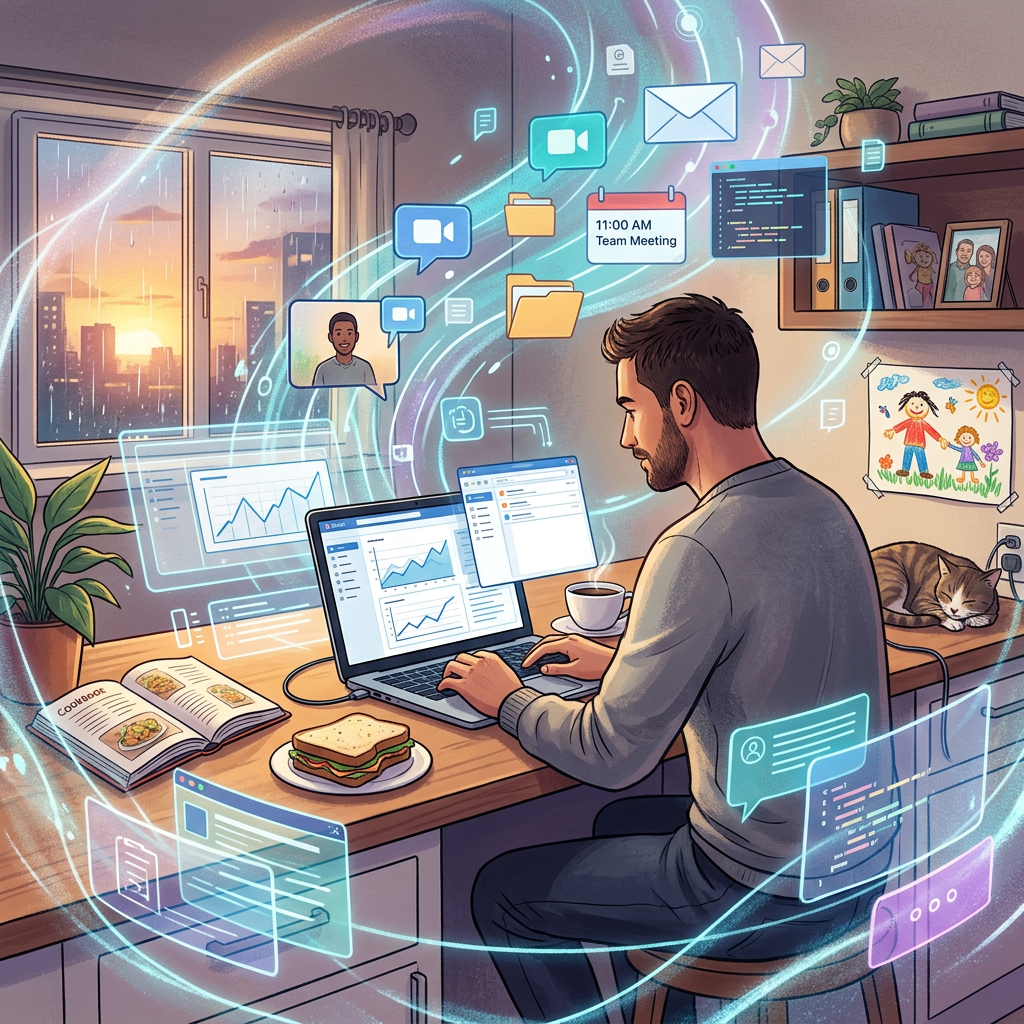
The distinction between work and life once seemed clear. Work belonged to offices, schedules, and defined hours. Life existed outside those boundaries, in spaces of rest, family, and personal time. Today, that separation is increasingly difficult to sustain. Digital technologies have dissolved the boundaries that once structured everyday life, creating a condition where work and life are no longer distinct, but continuously intertwined.
This condition, often described as work life blur, is not merely a cultural shift. It is deeply connected to the rise of data driven systems and the emergence of digital fatigue. Together, they redefine how time, attention, and human capacity are organized in the modern world.
The Collapse of Boundaries
Digital connectivity has transformed the organization of time and space. Work is no longer tied to a physical location. Emails arrive at all hours, messages demand immediate responses, and digital platforms enable continuous access to tasks and responsibilities.
What was once occasional has become expected. The ability to respond quickly is no longer seen as exceptional, but as normal. This creates a subtle but powerful shift. Work expands into spaces that were previously reserved for rest.
Gregg (2011) describes this phenomenon as the normalization of presence bleed, where work seeps into personal life through digital communication. The boundary between working time and non working time becomes porous, and eventually indistinguishable.
Data Systems and the Logic of Always On
At the core of this transformation are data driven systems.
Productivity tools, communication platforms, and performance tracking systems are designed to operate continuously. They generate data, monitor activity, and create expectations of responsiveness. Notifications, dashboards, and metrics reinforce a sense that work is ongoing and measurable at all times.
These systems are not neutral. They are built around a logic of optimization and efficiency. The more responsive and engaged individuals are, the more effectively the system functions.
This creates what can be described as an always on environment. Individuals are not explicitly required to work at all times, but the system makes disengagement difficult. Silence can be interpreted as absence. Delay can be seen as inefficiency.
In this context, work life blur is not simply a failure of personal boundaries. It is a structural condition produced by the design of digital systems.
Digital Fatigue as a Systemic Outcome
The continuous demands of always on systems contribute directly to digital fatigue.
Digital fatigue emerges from sustained cognitive and emotional load. Individuals must monitor multiple streams of information, respond to ongoing communication, and manage overlapping roles. The brain, however, is not designed for continuous engagement without rest.
Kahneman (2011) highlights the limits of cognitive capacity, emphasizing that attention and decision making are finite resources. When these resources are constantly taxed, performance declines and fatigue increases.
In a data driven environment, this strain becomes normalized. Fatigue is often interpreted as a personal issue, something to be managed through discipline or time management. Yet this framing overlooks the systemic nature of the problem.
Digital fatigue is not simply the result of overwork. It is the consequence of systems that are designed to operate without pause.
The Invisible Expansion of Labor
Another dimension of work life blur is the expansion of invisible labor.
Digital work involves not only formal tasks, but also continuous coordination, communication, and self management. Checking messages, responding to notifications, updating systems, and maintaining digital presence all require effort.
These activities are often not recognized as work, yet they consume time and energy. They extend the working day without being formally acknowledged.
This creates a paradox. While digital technologies promise efficiency, they can also increase the total amount of labor required to sustain participation in systems.
As a result, individuals may feel constantly busy without clear boundaries or periods of rest.
Emotional and Social Consequences
The blurring of work and life has significant emotional and social implications.
Constant connectivity can create a sense of pressure. The need to be available, responsive, and engaged can lead to anxiety and stress. The absence of clear boundaries makes it difficult to disengage, even during periods of rest.
Social relationships are also affected. Time that might have been spent in direct interaction is often mediated through digital communication. The quality of engagement can shift from deep and focused to fragmented and continuous.
Turkle (2011) suggests that while digital communication increases connection, it can reduce the depth of interaction, contributing to a sense of isolation despite constant contact.
Inequality in the Experience of Blur
Work life blur is not experienced equally.
For some, flexibility provides autonomy and opportunity. For others, particularly those in precarious or platform based work, constant connectivity is a requirement rather than a choice.
Digital systems can impose different forms of pressure depending on context. Knowledge workers may face expectations of constant availability, while gig workers may be subject to algorithmic scheduling and performance monitoring.
These differences highlight that work life blur is shaped by broader structures of inequality. The ability to set boundaries is not evenly distributed.
Rethinking Boundaries in a Data Driven World
Addressing work life blur requires more than individual solutions. It requires rethinking the design and governance of digital systems.
At the individual level, strategies such as limiting notifications, setting defined working hours, and creating spaces of disconnection can help. However, these measures are often insufficient when systems continue to demand engagement.
At the organizational level, there is a need to redefine expectations. Policies that respect boundaries, limit after hours communication, and prioritize well being are essential.
At the systemic level, platform design must be reconsidered. Systems that prioritize constant engagement may need to be redesigned to support periods of rest and disconnection.
A Data Justice Perspective
From a data justice perspective, work life blur can be understood through three dimensions.
Representation concerns how individuals are reflected in data systems. Metrics and performance indicators may reduce complex human activity to simplified measures.
Distribution relates to how the costs of constant connectivity are shared. While organizations benefit from increased responsiveness, individuals bear the burden of fatigue.
Governance addresses who designs and controls the systems that shape everyday life. Decisions about platform features, algorithms, and data use influence how boundaries are constructed or dissolved.
These dimensions highlight that work life blur is not only a personal experience, but also a question of power and justice.
Conclusion
Living without boundaries has become a defining condition of life in a data driven world. The blurring of work and life reflects deeper transformations in how time, attention, and labor are organized.
Digital fatigue is not an anomaly. It is a signal that human limits are being tested by systems that operate continuously.
Rethinking this condition requires shifting the focus from individual adaptation to systemic change. It involves recognizing that boundaries are not only personal choices, but also structural features shaped by technology and governance.
Ultimately, the challenge is to create a world where digital systems support human life, rather than consume it.
References
Gregg, M. (2011). Work’s Intimacy. Polity Press.
Kahneman, D. (2011). Thinking Fast and Slow. Farrar Straus and Giroux.
Turkle, S. (2011). Alone Together. Basic Books.


Leave a Reply