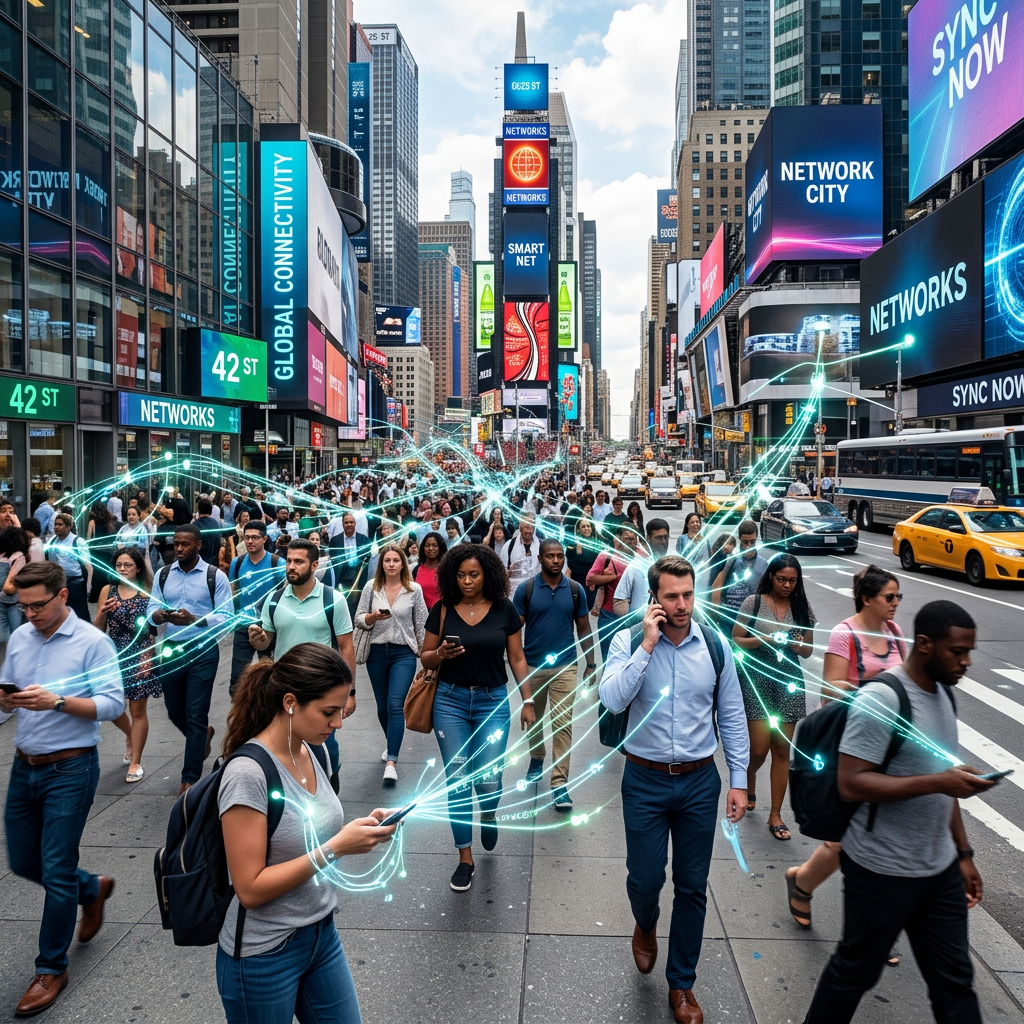
The Cost of Constant Connectivity on Human Life
Connectivity has become one of the defining features of contemporary life. Digital systems enable continuous communication, real time information, and seamless coordination across space and time. The promise is clear: greater efficiency, faster decisions, and closer connections.
Yet constant connectivity is not without cost.
What appears as convenience often conceals a deeper transformation in how time, attention, relationships, and even identity are structured. Living in a permanently connected environment reshapes not only how individuals interact with technology, but how they experience being human.
From Occasional Connection to Permanent Availability
Connectivity was once intermittent. Communication required specific moments and locations. Today, it is continuous.
Mobile devices, messaging platforms, and digital infrastructures ensure that individuals are always reachable. The boundary between online and offline has blurred, and in many contexts, disappeared entirely.
This shift creates a new expectation: permanent availability.
Messages are expected to be answered quickly. Updates are delivered instantly. Silence can be interpreted as absence or disengagement. Over time, responsiveness becomes normalized, and the absence of response becomes noticeable.
The result is a subtle but persistent pressure to remain connected.
The Transformation of Time
Constant connectivity alters the experience of time.
Time is no longer segmented into clear periods of work and rest. Instead, it becomes fragmented and continuous. Tasks overlap, interruptions occur frequently, and attention is divided across multiple streams.
Hartmut Rosa (2013) describes how technological acceleration compresses time, reducing opportunities for reflection and rest. In a connected environment, this compression becomes embedded in everyday life.
Moments that were once reserved for pause are now filled with information and interaction. Waiting, boredom, and idle time, which once provided space for reflection, are increasingly replaced by engagement.
Time becomes occupied rather than experienced.
Attention Under Continuous Demand
In a constantly connected world, attention is under continuous demand.
Digital systems are designed to capture and retain attention. Notifications, alerts, and personalized content create ongoing stimuli that require response. Individuals are drawn into cycles of engagement that are difficult to interrupt.
Davenport and Beck (2001) identify attention as a scarce resource in an information rich environment. Constant connectivity intensifies this scarcity by increasing the number of demands placed on attention.
As attention becomes fragmented, the ability to focus deeply declines. Tasks are performed in shorter intervals, and cognitive effort is distributed across multiple activities.
This fragmentation reduces not only efficiency, but also the quality of experience.
The Blurring of Work and Life
One of the most visible consequences of constant connectivity is the erosion of boundaries between work and personal life.
Work extends beyond traditional hours through emails, messages, and digital platforms. Personal time becomes interwoven with professional obligations. The distinction between being at work and being at rest becomes increasingly unclear.
Gregg (2011) describes this as the extension of work into intimate spaces, where digital technologies enable continuous engagement with professional tasks.
This blurring creates a condition where individuals are never fully disengaged. Even in moments of rest, the possibility of interruption remains.
Over time, this can lead to fatigue and reduced well being.
Emotional and Psychological Costs
The effects of constant connectivity are not only structural. They are also emotional and psychological.
Continuous engagement can create a sense of pressure. The need to respond, to remain visible, and to keep up with information can lead to stress and anxiety.
Turkle (2011) suggests that while digital technologies increase connection, they can also reduce the depth of relationships. Interaction becomes frequent but shallow, leading to a paradoxical sense of isolation.
The absence of disconnection makes it difficult to recover. Without clear boundaries, individuals may experience ongoing mental strain.
Digital fatigue emerges not as a temporary condition, but as a sustained state.
The Illusion of Control
Connectivity often creates the impression of control.
Access to information, real time updates, and communication tools suggest that individuals can manage their environments more effectively. However, this control is often limited.
The volume of information and the speed of interaction can lead to overwhelm. Individuals may feel compelled to engage, even when it is not necessary or beneficial.
This creates a paradox. Connectivity promises empowerment, but can produce dependency. Individuals become responsive to systems rather than in control of them.
Inequality in Connectivity
The experience of constant connectivity is not uniform.
For some, connectivity provides flexibility and opportunity. For others, it creates obligation and constraint.
Workers in digital environments may face expectations of constant availability. Platform workers may be subject to algorithmic management that requires continuous engagement. Others may depend on connectivity for access to services, making disconnection difficult.
These differences highlight that connectivity is shaped by broader social and economic conditions. The costs of connectivity are unevenly distributed.
Rethinking Connectivity
Addressing the costs of constant connectivity requires rethinking how systems are designed and used.
At the individual level, practices such as managing notifications, setting boundaries, and creating periods of disconnection can help. However, these strategies have limits in environments that demand constant engagement.
At the organizational level, expectations around availability and responsiveness must be reconsidered. Policies that support disconnection and protect personal time are essential.
At the systemic level, the design of digital platforms must be examined. Systems that prioritize engagement and continuous interaction may need to be reconfigured to support well being.
A Data Justice Perspective
From a data justice perspective, constant connectivity raises important questions.
Representation concerns how individuals are captured in data systems, often as continuously active participants.
Distribution relates to how the benefits and burdens of connectivity are allocated.
Governance addresses who designs and controls systems that shape connectivity.
These dimensions highlight that connectivity is not only a technical condition, but a social and political one.
Conclusion
Constant connectivity is transforming human life.
It reshapes time, fragments attention, blurs boundaries, and introduces new forms of pressure. While it offers significant benefits, it also imposes costs that are often overlooked.
The challenge is not to reject connectivity, but to understand its limits.
Living well in a connected world requires creating space for disconnection, reflection, and rest. It requires designing systems that support human capacities rather than exceed them.
Ultimately, the goal is not to be constantly connected, but to remain meaningfully connected in ways that sustain human life.
References
Davenport, T., and Beck, J. (2001). The Attention Economy. Harvard Business School Press.
Gregg, M. (2011). Work’s Intimacy. Polity Press.
Rosa, H. (2013). Social Acceleration. Columbia University Press.
Turkle, S. (2011). Alone Together. Basic Books.


Leave a Reply