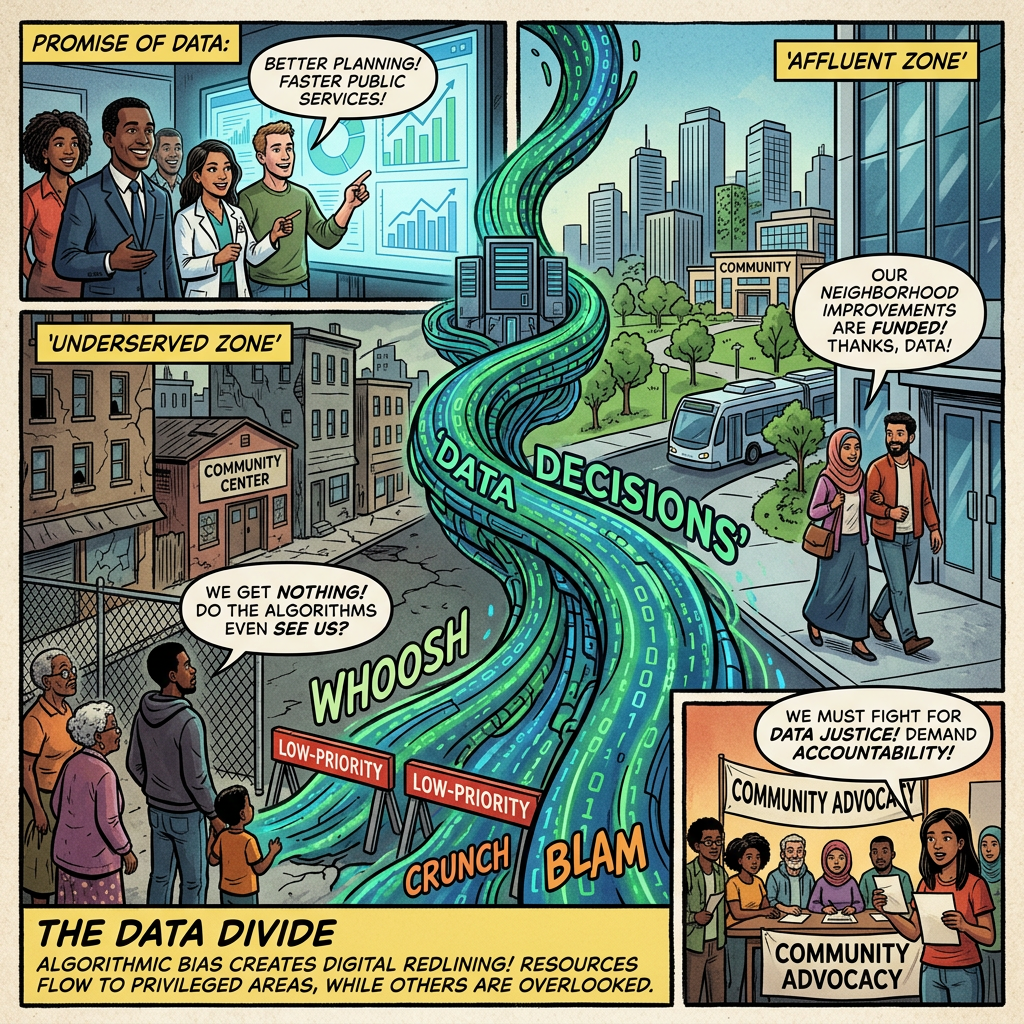
Data driven decision making has become one of the defining characteristics of contemporary society. Governments increasingly rely on data analytics to manage public services, corporations use predictive systems to optimize markets and consumer behavior, and institutions across sectors depend on algorithms to guide decisions once made primarily through human judgment. From finance and healthcare to education and policing, data systems now shape how opportunities, risks, and resources are distributed.
The appeal of data driven systems is understandable.
Data promises efficiency, consistency, and objectivity. Automated systems can process information at scales impossible for human institutions alone. Predictive models appear capable of identifying patterns, improving accuracy, and reducing uncertainty in complex environments. In a world increasingly organized around speed and optimization, data driven decision making is often presented as both rational and necessary.
Yet the growing reliance on data also produces significant social consequences.
These systems do not operate independently from society. They are shaped by institutional priorities, historical inequalities, and political assumptions that influence how data is collected, interpreted, and used. As data driven systems expand into everyday life, they increasingly influence not only administrative processes, but also human relationships, social mobility, institutional trust, and democratic accountability.
Understanding the social consequences of data driven decisions therefore requires looking beyond technical performance alone.
The Promise of Objectivity
One of the primary reasons institutions adopt data driven systems is the belief that data produces more objective decisions.
Algorithms are often perceived as less biased than human judgment because they rely on measurable indicators and statistical analysis rather than emotion or personal preference. In many contexts, automation is introduced specifically to reduce inconsistency and improve efficiency.
However, the assumption of neutrality is deeply contested.
Scholars in critical data studies argue that data systems inherit the inequalities and assumptions embedded within the social environments from which data is produced. Bowker and Star (1999) explain that classification systems are never neutral because they reflect institutional priorities regarding what becomes visible and measurable.
Similarly, Safiya Umoja Noble (2018) demonstrates that search algorithms can reproduce racial and gender bias while appearing technologically objective. The issue is not simply flawed programming. It is that data systems learn from historical and social conditions already shaped by inequality.
As a result, decisions presented as impartial may reinforce existing social hierarchies.
The Transformation of Institutional Decision Making
Data driven systems are transforming how institutions operate.
In healthcare, predictive analytics are used to identify patients considered high risk. In finance, credit scoring systems determine access to loans and insurance. In education, student performance data guides evaluation and intervention. In policing, predictive systems attempt to identify areas or individuals associated with future criminal activity.
These systems increasingly influence decisions that directly affect human lives.
Virginia Eubanks (2018), in Automating Inequality, demonstrates how automated systems in public welfare programs can intensify burdens on poor communities by reducing opportunities for contextual understanding and human discretion. Individuals affected by automated classifications may struggle to challenge decisions because the systems themselves are opaque and difficult to interpret.
This creates a significant institutional shift.
Decision making becomes distributed across databases, algorithms, and predictive models rather than located solely within identifiable human actors. Responsibility becomes fragmented, making accountability more difficult to establish when harmful outcomes occur.
The consequence is not only technological change, but also a transformation in how institutional power operates.
Social Sorting and Unequal Treatment
Data driven systems frequently categorize populations according to risk, value, productivity, or behavioral prediction.
David Lyon (2018) describes this process as social sorting, where surveillance and data systems classify individuals in ways that influence access to opportunities and institutional treatment. These classifications shape who receives attention, support, scrutiny, or exclusion.
Social sorting can produce unequal consequences even when systems appear technically efficient.
Predictive policing systems may concentrate surveillance within historically marginalized communities because they rely on historical arrest data shaped by unequal policing practices. Automated hiring systems may disadvantage applicants whose educational or employment histories differ from institutional norms. Credit scoring systems may reinforce economic inequality by limiting financial access for individuals lacking formal financial histories.
Cathy O’Neil (2016) argues that many algorithmic systems function as “weapons of math destruction” because they scale inequality while remaining resistant to public scrutiny.
In this context, data driven decisions do not merely reflect social inequality. They can actively reproduce and intensify it.
The Erosion of Human Context
One of the most significant consequences of data driven systems is the reduction of complex human experiences into measurable indicators.
Institutions increasingly rely on metrics, scores, probabilities, and predictive categories to guide decisions. While quantification can improve administrative efficiency, it also risks oversimplifying social reality.
Experiences such as vulnerability, dignity, trauma, discrimination, and social exclusion are often difficult to capture fully through data alone.
Muller (2018) warns that excessive dependence on metrics can distort institutional priorities by privileging measurable outcomes over meaningful human realities. People become represented through data profiles rather than understood through broader social and personal contexts.
This reduction can produce forms of institutional distance.
Individuals affected by automated systems may feel that decisions are imposed mechanically rather than understood relationally. The absence of human engagement can weaken perceptions of fairness and legitimacy, particularly when outcomes significantly affect people’s lives.
Efficiency may increase while social trust declines.
Behavioral Influence and the Shaping of Everyday Life
Data driven systems do not only evaluate behavior. They increasingly shape it.
Digital platforms continuously collect behavioral data in order to personalize content, predict preferences, and maximize engagement. Recommendation systems influence what people watch, read, purchase, and discuss. Social media algorithms shape visibility and interaction within public discourse.
Shoshana Zuboff (2019) argues that surveillance capitalism depends not only on monitoring behavior, but also on influencing future actions through predictive systems and behavioral modification.
This creates important social consequences.
Human attention becomes increasingly managed through algorithmic infrastructures designed to optimize engagement and profitability. Individuals interact with environments structured by systems that continuously adapt to influence preferences and decision making.
The result is a subtle transformation of autonomy.
Choices may appear individual while being shaped by systems optimized to guide behavior toward particular outcomes.
Data Inequality and Differential Participation
The social consequences of data driven systems are not experienced equally.
Some populations possess greater access to digital infrastructure, technological literacy, and institutional visibility than others. Individuals with stable internet access, financial integration, and extensive digital histories are often more legible to data systems and therefore more likely to receive institutional recognition.
Meanwhile, marginalized populations may experience either invisibility or excessive surveillance.
Couldry and Mejias (2019) argue that contemporary digital economies create unequal relationships between those who extract data and those whose lives become sources of data extraction. Economic value becomes concentrated among institutions that control computational infrastructures and analytical capacity.
This means that participation in data driven society often occurs under unequal conditions of power.
Some groups benefit from personalization, convenience, and opportunity, while others experience exclusion, monitoring, or reduced institutional autonomy.
Democratic Accountability and Transparency
The expansion of data driven governance also raises concerns regarding democracy and accountability.
Many algorithmic systems operate through technical processes that are difficult for the public to understand or challenge. Proprietary technologies, complex computational models, and institutional secrecy can limit transparency regarding how decisions are made.
Frank Pasquale (2015) describes this condition as the emergence of “black box” systems where important social decisions occur within opaque technological infrastructures shielded from meaningful public oversight.
This opacity creates democratic risks.
When citizens cannot understand how decisions affecting employment, finance, healthcare, or public services are produced, accountability becomes weakened. Institutional authority may shift from publicly visible processes toward technical systems controlled by corporations and specialized experts.
The issue is therefore not only technological complexity, but also political legitimacy.
A Data Justice Perspective
A data justice perspective provides a broader framework for understanding these challenges.
Linnet Taylor (2017) argues that data justice concerns fairness in visibility, representation, and treatment within digital systems. This perspective recognizes that data infrastructures shape social power and therefore must be evaluated according to their social consequences rather than technical efficiency alone.
Representation concerns whose experiences become visible within datasets and whose remain excluded.
Distribution examines how the benefits and harms of data systems are allocated across populations.
Governance focuses on who controls data infrastructures, defines categories, and establishes the rules shaping digital participation.
From this perspective, the social consequences of data driven decisions are inseparable from broader questions of inequality, democracy, and institutional power.
Toward More Human Centered Systems
Addressing the social consequences of data driven decisions requires moving beyond assumptions that technological efficiency alone represents progress.
At the institutional level, transparency and accountability mechanisms are essential to ensure that automated systems can be understood and challenged.
At the technical level, systems should be evaluated not only for predictive accuracy, but also for unequal impacts across different communities.
At the societal level, public debate about technology must include broader ethical and political questions regarding autonomy, dignity, and justice.
Most importantly, human judgment and contextual understanding should not disappear entirely from institutional decision making.
Data can support governance, but it cannot fully replace human responsibility.
Conclusion
Data driven decisions are transforming contemporary society in profound ways.
These systems influence access to opportunities, shape institutional treatment, organize visibility, and structure everyday behavior. While data driven systems promise efficiency and objectivity, they also produce significant social consequences related to inequality, surveillance, accountability, and human autonomy.
The challenge is not simply whether societies should use data.
The deeper challenge is determining how data systems can remain accountable to democratic values and human dignity while operating at increasing scale and influence.
Understanding the social consequences of data driven decisions therefore requires recognizing that technology is never purely technical.
It is fundamentally connected to power, governance, and the organization of social life itself.
References
Bowker, G. C., & Star, S. L. (1999). Sorting Things Out: Classification and Its Consequences. MIT Press.
Couldry, N., & Mejias, U. A. (2019). The Costs of Connection: How Data Is Colonizing Human Life and Appropriating It for Capitalism. Stanford University Press.
Eubanks, V. (2018). Automating Inequality: How High-Tech Tools Profile, Police, and Punish the Poor. St. Martin’s Press.
Lyon, D. (2018). The Culture of Surveillance: Watching as a Way of Life. Polity Press.
Muller, J. Z. (2018). The Tyranny of Metrics. Princeton University Press.
Noble, S. U. (2018). Algorithms of Oppression: How Search Engines Reinforce Racism. NYU Press.
O’Neil, C. (2016). Weapons of Math Destruction. Crown Publishing.
Pasquale, F. (2015). The Black Box Society. Harvard University Press.
Taylor, L. (2017). “What Is Data Justice? The Case for Connecting Digital Rights and Freedoms Globally.” Big Data & Society, 4(2).
Zuboff, S. (2019). The Age of Surveillance Capitalism. PublicAffairs.


Leave a Reply