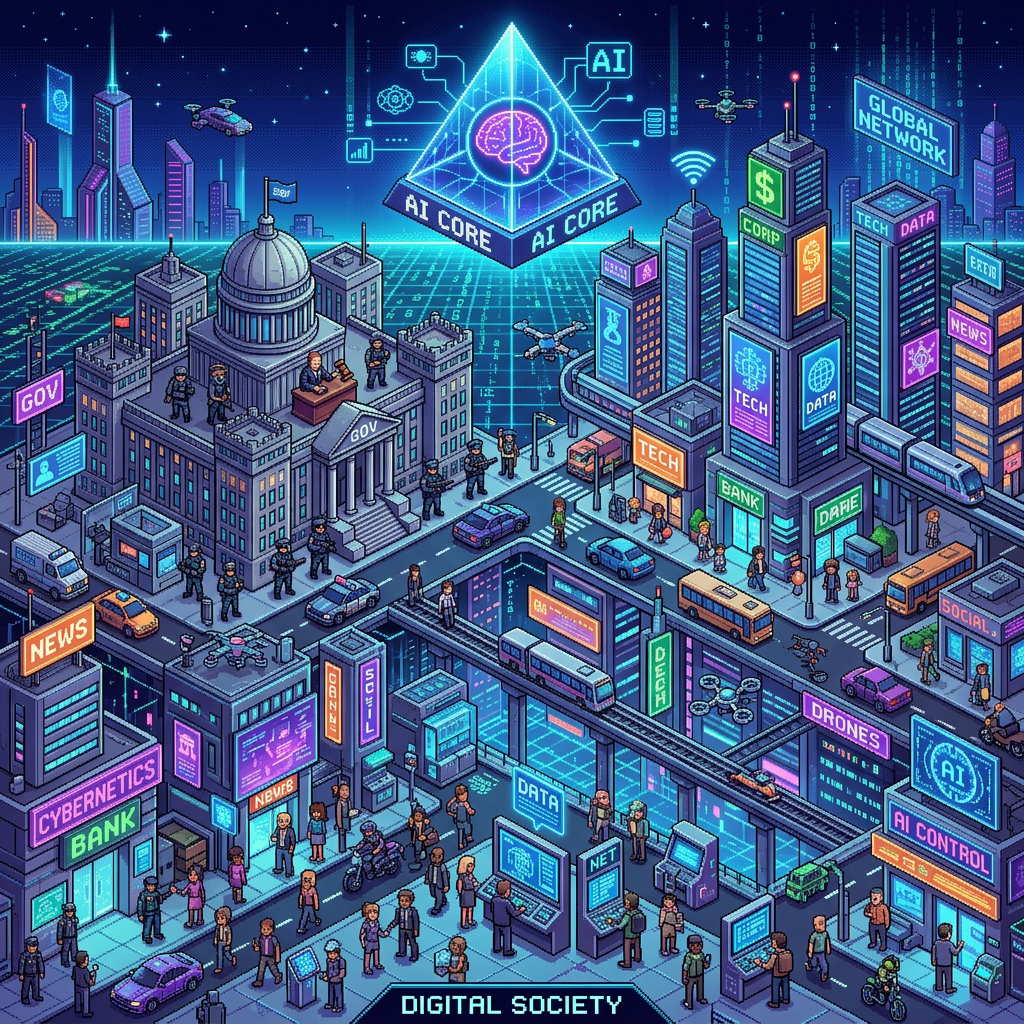
Technology increasingly shapes how contemporary societies function. Governments rely on digital infrastructures to manage populations and public services, corporations depend on algorithmic systems to optimize markets and consumer behavior, and individuals interact daily with technologies that influence communication, mobility, employment, and access to information. Artificial intelligence systems, predictive analytics, and automated platforms are often presented as symbols of progress capable of making society more efficient, connected, and rational.
Yet technological sophistication does not necessarily produce understanding.
Many contemporary systems operate through enormous computational capability while remaining detached from the social realities they influence. Data can be processed at extraordinary speed, predictions can be generated with remarkable accuracy, and automated decisions can be implemented at massive scale, yet these systems may still fail to understand human complexity, historical context, ethical consequences, or lived experience.
This creates a growing danger within digital society.
Technology without understanding risks becoming a blind system.
Blind systems are not necessarily technically flawed. In many cases, they function exactly as designed. The problem is deeper. They operate efficiently while lacking meaningful awareness of the social realities, inequalities, and human consequences embedded within the environments they govern.
The Expansion of Data Driven Systems
Contemporary institutions increasingly depend on data driven technologies.
Governments use predictive systems to allocate resources, identify risks, and manage public administration. Financial institutions rely on algorithmic evaluations to determine creditworthiness and insurance eligibility. Employers use automated systems to assess productivity and screen applicants. Social media platforms organize visibility and communication through recommendation algorithms.
These systems promise efficiency, consistency, and scalability.
Because computational systems can process information more rapidly than humans, automation is frequently viewed as more objective and rational than traditional forms of institutional decision making. Data driven technologies appear capable of reducing uncertainty by transforming social life into measurable patterns and predictive indicators.
However, the ability to process information is not equivalent to understanding reality.
Machine systems identify correlations and patterns within data, but they do not possess social consciousness, historical awareness, or ethical reasoning in the human sense. They can classify behavior statistically without understanding the conditions shaping that behavior.
This distinction is fundamental.
Data Is Not the Same as Reality
One of the central risks of blind systems is the assumption that data fully represents social reality.
Data systems rely on categories, measurements, and indicators designed to simplify complex environments into manageable forms. While simplification is necessary for computation and administration, it also creates limitations.
James C. Scott (1998), in Seeing Like a State, argues that large institutions often fail when they attempt to govern complex societies through overly simplified systems of classification and measurement. Administrative systems seek legibility, but human societies contain forms of complexity that exceed institutional simplification.
Data therefore always reflects partial reality rather than reality in its entirety.
Experiences such as vulnerability, discrimination, emotional suffering, cultural identity, and social exclusion are difficult to quantify fully. Yet institutions increasingly rely on numerical indicators and predictive systems to guide decisions affecting human lives.
The danger emerges when institutions begin treating measurable information as complete understanding.
Blind systems mistake visibility for comprehension.
The Illusion of Neutral Technology
Technological systems often appear objective because they rely on computational logic rather than direct human judgment.
Algorithms process data statistically, generate predictions, and apply classifications according to predefined criteria. This creates the impression that automated systems operate outside politics, culture, or social bias.
However, scholars in critical technology studies argue that technological systems inherit the assumptions and inequalities embedded within the societies that produce them.
Safiya Umoja Noble (2018) demonstrates how search engines can reproduce racial and gender bias while appearing technologically neutral. Ruha Benjamin (2019) similarly argues that emerging technologies often reinforce existing social hierarchies under the appearance of innovation and efficiency.
Blind systems therefore do not emerge because technology lacks intelligence.
They emerge because systems process information without adequately understanding the historical, political, and social conditions shaping the data itself.
Technology may appear neutral while reproducing deeply unequal outcomes.
Automation Without Context
Automated systems are highly effective in environments governed by stable and measurable rules.
However, complex social life depends heavily on context.
Human decisions often require interpretation shaped by culture, ethics, history, emotion, and social relationships. Questions involving justice, vulnerability, fairness, and responsibility cannot always be resolved through statistical optimization alone.
Virginia Eubanks (2018), in Automating Inequality, shows how automated welfare systems in the United States frequently harmed vulnerable populations because systems reduced complex human realities into rigid administrative categories.
The systems operated efficiently according to institutional objectives.
Yet efficiency alone did not produce justice or understanding.
Automated systems can identify patterns associated with risk, but they cannot fully understand the lived experience of poverty, exclusion, or social marginalization. Data profiles simplify individuals into measurable indicators while broader realities remain partially invisible.
The result is a system that functions operationally while remaining socially blind.
The Reduction of Human Complexity
Blind systems emerge partly because technological systems require reduction.
Computational infrastructures depend on categories, variables, and measurable patterns. Human complexity must therefore be translated into forms compatible with data analysis and algorithmic processing.
This process inevitably excludes aspects of human life that resist quantification.
Emotions, cultural meanings, moral dilemmas, personal histories, and political experiences cannot easily be converted into predictive variables. Yet institutions increasingly rely on technologies designed precisely around such reduction.
Muller (2018) warns that excessive dependence on metrics can distort institutional priorities by privileging measurable indicators over meaningful realities.
As societies become more dependent on data systems, there is a growing risk that what cannot be measured becomes institutionally invisible.
Blind systems govern what they can count while neglecting what they cannot fully comprehend.
Prediction and the Limits of Machine Intelligence
Artificial intelligence systems are increasingly valued for predictive capability.
Machine learning models identify patterns within historical data in order to forecast future outcomes. Predictive systems are used in policing, healthcare, finance, education, and labor management because they promise greater efficiency and accuracy.
However, prediction has important limits.
Human beings are not static variables operating according to fixed probabilities. Social behavior is shaped by changing political conditions, cultural dynamics, economic pressures, and personal choices that remain partially unpredictable.
Hannah Arendt (1958) emphasized that human action involves spontaneity and unpredictability precisely because individuals possess the capacity for reflection and political agency.
Machine systems may calculate probabilities effectively, but probability is not equivalent to understanding human possibility.
Blind systems risk treating people according to statistical expectations rather than recognizing their complexity and capacity for change.
Institutional Distance and Democratic Risks
As technological systems expand, institutions may become increasingly distant from the populations they govern.
Traditional forms of administration involved direct human interaction and identifiable responsibility. Individuals could negotiate, explain circumstances, and seek contextual understanding from institutional actors.
Blind systems alter this relationship.
Frank Pasquale (2015) describes many algorithmic infrastructures as “black boxes” because decision making processes remain opaque even to those directly affected by them. Citizens may be evaluated, classified, or excluded through systems they cannot understand or meaningfully challenge.
This creates risks not only for fairness, but also for democracy itself.
When institutional authority becomes embedded within opaque technical systems, public accountability weakens. Decisions affecting employment, mobility, healthcare, or access to services may occur through infrastructures largely inaccessible to democratic scrutiny.
Technology without understanding therefore becomes politically dangerous because it concentrates authority within systems detached from public visibility and human accountability.
The Human Cost of Blind Systems
The consequences of blind systems are rarely distributed equally.
Marginalized communities often experience the harshest effects of automated governance and data driven classification. Predictive policing systems disproportionately target historically over surveilled populations. Automated hiring systems may disadvantage individuals outside institutional norms. Welfare systems may intensify scrutiny toward vulnerable communities.
David Lyon (2018) describes contemporary surveillance systems as mechanisms of social sorting where populations are categorized and managed according to institutional priorities.
Blind systems frequently reinforce these inequalities because they inherit historical biases embedded within data and institutional structures.
The issue is not only technological malfunction.
The deeper problem is that systems optimized for efficiency may operate without meaningful awareness of the human consequences they produce.
A Data Justice Perspective
A data justice perspective provides an important framework for understanding the risks of blind systems.
Linnet Taylor (2017) argues that digital systems should be evaluated according to fairness in representation, visibility, and treatment rather than technical performance alone.
Representation concerns whose experiences are recognized within data systems and whose remain excluded or distorted.
Distribution examines how the benefits and harms of technological systems are allocated across populations.
Governance focuses on who controls digital infrastructures and how accountability is maintained within automated environments.
From this perspective, understanding cannot be separated from justice.
Technological systems that process data efficiently while reproducing exclusion, inequality, or institutional opacity cannot be considered socially intelligent systems.
Toward Technology With Understanding
Addressing the risks of blind systems requires rethinking the relationship between technology and human judgment.
At the institutional level, automated systems should remain subject to transparency, oversight, and meaningful opportunities for public challenge.
At the technical level, systems should be evaluated not only for efficiency and predictive accuracy, but also for social consequences, unequal impacts, and ethical limitations.
At the societal level, technological development must include broader democratic discussions regarding power, accountability, and human dignity.
Most importantly, societies must recognize that information processing alone does not produce wisdom or understanding.
Human judgment remains essential precisely because complex social realities cannot be fully reduced to computational categories.
Conclusion
Technology is transforming contemporary society through increasingly sophisticated systems of automation, prediction, and data analysis.
These systems offer important possibilities for coordination, efficiency, and innovation. Yet technological capability alone does not guarantee understanding.
Blind systems emerge when institutions mistake measurable data for complete social knowledge, when efficiency replaces contextual judgment, and when automation operates without meaningful awareness of human complexity.
The challenge is therefore not simply technological.
It is fundamentally political and ethical because it concerns whether societies can maintain human understanding, democratic accountability, and social justice within environments increasingly governed through automated systems.
Technology without understanding risks creating systems that function efficiently while remaining blind to the realities of the people they govern.
References
Arendt, H. (1958). The Human Condition. University of Chicago Press.
Benjamin, R. (2019). Race After Technology: Abolitionist Tools for the New Jim Code. Polity Press.
Eubanks, V. (2018). Automating Inequality: How High-Tech Tools Profile, Police, and Punish the Poor. St. Martin’s Press.
Lyon, D. (2018). The Culture of Surveillance: Watching as a Way of Life. Polity Press.
Muller, J. Z. (2018). The Tyranny of Metrics. Princeton University Press.
Noble, S. U. (2018). Algorithms of Oppression: How Search Engines Reinforce Racism. NYU Press.
Pasquale, F. (2015). The Black Box Society. Harvard University Press.
Scott, J. C. (1998). Seeing Like a State. Yale University Press.
Taylor, L. (2017). “What Is Data Justice? The Case for Connecting Digital Rights and Freedoms Globally.” Big Data & Society, 4(2).


Leave a Reply