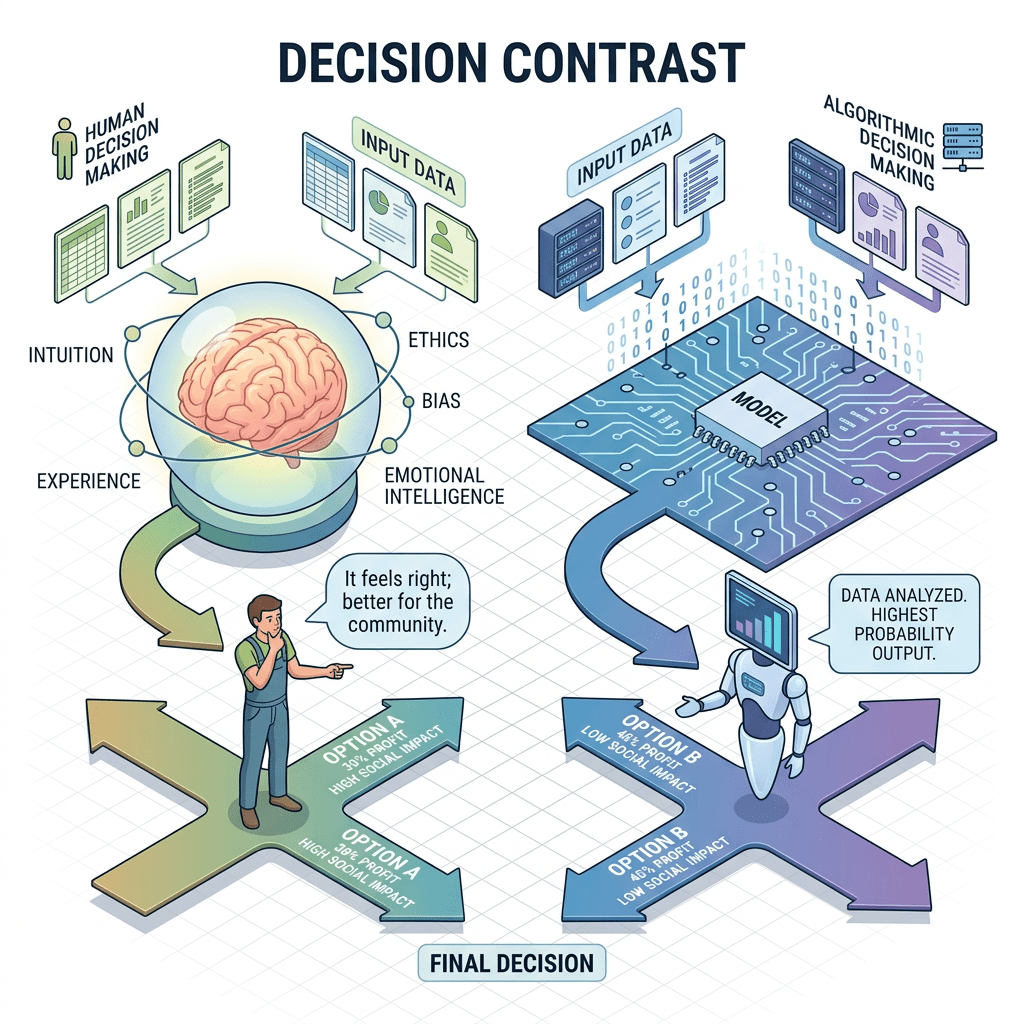
Automated decision making has become deeply embedded within contemporary society. Governments use algorithms to manage welfare systems and assess public risks, corporations rely on predictive analytics to evaluate consumers and workers, and digital platforms organize visibility and participation through recommendation systems powered by machine learning. Across finance, healthcare, education, policing, and employment, decisions once made primarily through human judgment are increasingly delegated to computational systems.
The appeal of automation is clear.
Automated systems can process enormous amounts of information rapidly, identify statistical patterns beyond human capability, and operate continuously at large scale. In environments characterized by growing complexity and vast data flows, automation appears to offer efficiency, consistency, and objectivity.
Yet the expansion of automated decision making also raises a fundamental question.
What happens to human judgment in societies increasingly governed through algorithms?
This question is not merely technical. It concerns how societies understand responsibility, ethics, accountability, and the meaning of decision making itself. Human judgment involves interpretation, contextual awareness, moral reflection, and social understanding in ways that cannot always be reduced to computational calculation.
As automation expands, the role of human judgment becomes both more fragile and more important.
The Rise of Automated Decision Systems
Automated systems increasingly influence decisions affecting everyday life.
Algorithms evaluate creditworthiness, predict consumer behavior, identify fraud, rank job applicants, prioritize healthcare treatment, and guide policing strategies. Educational systems rely on predictive analytics to assess student performance, while social media platforms organize public visibility through recommendation algorithms.
These systems operate through statistical analysis and predictive modeling.
Machine learning systems identify patterns within historical data and generate classifications or predictions based on probabilities. Because computational systems can process information at scales beyond human capacity, institutions often view automation as more efficient and reliable than traditional administrative processes.
However, efficiency is not the same as understanding.
Virginia Eubanks (2018), in Automating Inequality, demonstrates how automated welfare systems can intensify inequality by embedding rigid classifications into institutional infrastructures. Decisions affecting vulnerable populations become shaped by technical systems that often lack contextual sensitivity and meaningful accountability.
Automation therefore transforms not only administration, but also the nature of institutional judgment itself.
Human Judgment Beyond Calculation
Human judgment involves more than selecting outcomes based on measurable variables.
People interpret meaning, consider context, reflect ethically, and respond to uncertainty in ways deeply connected to social experience. Judgment often requires balancing competing values rather than merely optimizing measurable outcomes.
Hannah Arendt (1968) argued that judgment is central to political and moral life because individuals must navigate complex situations where rules alone cannot fully determine appropriate action.
This dimension of judgment becomes especially important in environments involving ambiguity, vulnerability, or ethical conflict.
Automated systems operate differently.
Algorithms process structured information according to predefined objectives and statistical relationships. While they can generate predictions with remarkable speed and accuracy, they do not possess moral awareness, empathy, or lived experience in the human sense.
This distinction matters because many institutional decisions involve questions that cannot be resolved through probability alone.
The Illusion of Objective Decisions
Automated systems are often presented as objective alternatives to human judgment.
Because algorithms rely on data and statistical models, they appear less susceptible to personal bias, emotion, or inconsistency. Institutions frequently adopt automated systems precisely because they promise standardized decision making.
However, scholars in critical data studies have shown that algorithmic systems inherit the assumptions and inequalities embedded within historical data and institutional environments.
Cathy O’Neil (2016) argues that many predictive systems function as “weapons of math destruction” because they reproduce and scale existing social inequalities while appearing neutral and scientific.
Similarly, Safiya Umoja Noble (2018) demonstrates how search algorithms can reinforce racial and gender bias while maintaining the appearance of computational objectivity.
Automated decisions are therefore never entirely detached from human choices.
The data selected, categories defined, objectives prioritized, and outcomes optimized all reflect institutional assumptions and political values.
The appearance of neutrality can obscure the social and ethical dimensions of automated systems.
Context and the Limits of Automation
One of the greatest limitations of automated decision making is the difficulty of understanding context.
Human situations are often shaped by social conditions, historical inequalities, emotional experiences, and unpredictable circumstances that resist simplification into measurable variables. Algorithms depend on classification and standardization, yet many aspects of human life remain context dependent and ambiguous.
James C. Scott (1998), in Seeing Like a State, argues that large scale administrative systems often fail when they oversimplify complex social realities in pursuit of legibility and control.
Automated systems face similar limitations.
A predictive model may identify someone as financially risky without understanding structural poverty. An algorithm may classify a student as underperforming without recognizing personal hardship or unequal educational conditions. A hiring system may reject applicants whose experiences fall outside institutional norms despite possessing valuable capabilities.
Human judgment remains important precisely because human lives cannot always be reduced to stable categories and predictive indicators.
Accountability and the Problem of Opacity
The expansion of automated decisions also complicates accountability.
Traditional institutional decisions were generally associated with identifiable actors and visible procedures. Individuals could question officials, seek explanations, and challenge outcomes through administrative processes.
Automated systems alter this relationship.
Frank Pasquale (2015) describes many algorithmic systems as “black boxes” because their internal operations remain opaque even to those affected by them. Decisions may emerge from complex computational processes that are difficult to interpret or contest publicly.
This creates a significant democratic problem.
When automated systems influence access to healthcare, employment, education, credit, or public services, individuals may struggle to understand why decisions were made or who bears responsibility for harmful outcomes.
Human judgment includes not only decision making itself, but also accountability for decisions.
Automation risks weakening this connection.
Human Judgment and Ethical Responsibility
Automated systems can optimize efficiency, but they cannot assume ethical responsibility.
Questions involving fairness, dignity, justice, and social harm require moral reflection that extends beyond computational logic. Institutions frequently confront situations where competing values cannot be resolved through technical calculation alone.
Amartya Sen (2009) argues that justice depends on evaluating how social arrangements affect human capabilities and freedoms rather than simply optimizing institutional procedures.
This perspective highlights the limitations of purely technical approaches to governance.
Automated systems may calculate probabilities effectively, but they do not understand suffering, vulnerability, or political responsibility. Ethical reasoning depends partly on human capacities for empathy, interpretation, and moral reflection.
Human judgment therefore remains essential precisely because societies involve ethical complexity irreducible to data alone.
Behavioral Influence and the Delegation of Choice
Automated systems increasingly shape not only institutional decisions, but also human behavior itself.
Recommendation algorithms influence cultural consumption, political communication, and social interaction. Navigation systems guide movement, while personalized platforms continuously adapt environments according to behavioral data.
Shoshana Zuboff (2019) argues that contemporary digital systems seek not only to predict behavior, but also to influence and modify future actions through continuous data analysis.
This creates subtle forms of dependency.
Individuals increasingly rely on automated systems to organize information, prioritize options, and guide everyday decisions. Over time, excessive dependence on automation may weaken opportunities for reflection, uncertainty, and independent judgment.
Human judgment risks becoming secondary within environments optimized for automated guidance.
The Unequal Consequences of Automated Decisions
The effects of automation are not distributed equally.
Marginalized communities often experience greater exposure to predictive surveillance, automated welfare monitoring, and algorithmic risk assessment systems. Automated decision making may intensify existing inequalities because systems rely on historical data shaped by unequal social conditions.
Ruha Benjamin (2019) argues that technological systems frequently reinforce social hierarchies while presenting themselves as innovative and objective.
This means that the decline of human judgment may disproportionately affect vulnerable populations already subject to institutional scrutiny.
When opportunities for contextual understanding and discretion disappear, inequality can become embedded more deeply within technical infrastructures.
Automation therefore has political consequences extending beyond efficiency alone.
A Data Justice Perspective
A data justice perspective offers an important framework for understanding human judgment in automated societies.
Linnet Taylor (2017) argues that digital systems should be evaluated according to fairness in representation, visibility, and treatment rather than technical performance alone.
Representation concerns whose experiences and realities are reflected within datasets and predictive systems.
Distribution examines how the benefits and harms of automation are allocated across populations.
Governance focuses on who controls automated infrastructures and how accountability is maintained.
From this perspective, preserving human judgment is not simply about maintaining human authority over machines.
It is about protecting democratic accountability, ethical reflection, and social justice within increasingly automated environments.
Toward Human Centered Decision Making
Recognizing the importance of human judgment does not require rejecting automation entirely.
Automated systems can support institutions by processing information efficiently, identifying patterns, and reducing certain forms of administrative burden. However, decisions involving significant social consequences should not rely exclusively on computational systems detached from human oversight.
At the institutional level, transparency and accountability mechanisms are essential to ensure automated decisions can be understood and challenged.
At the technical level, systems should be evaluated not only for predictive accuracy, but also for ethical consequences and unequal impacts.
At the societal level, public discourse about automation should include broader discussions about dignity, responsibility, and democratic values rather than focusing solely on efficiency.
Most importantly, societies must recognize that judgment is not only a technical process.
It is also a human and political responsibility.
Conclusion
Automated decision making is transforming contemporary society at extraordinary scale.
Algorithms increasingly influence governance, labor, healthcare, finance, communication, and social participation through systems optimized for prediction and efficiency. While these technologies offer important benefits, they also raise profound questions about ethics, accountability, and human autonomy.
Human judgment remains essential because complex societies involve ambiguity, moral conflict, and contextual realities that cannot be fully reduced to data and computation.
The challenge is therefore not simply whether automation should expand.
The deeper challenge concerns how societies preserve human responsibility, ethical reflection, and democratic accountability within environments increasingly shaped by automated systems.
The future of decision making will depend not only on technological capability, but also on whether human judgment remains central in societies governed through data and algorithms.
References
Arendt, H. (1968). Between Past and Future. Viking Press.
Benjamin, R. (2019). Race After Technology: Abolitionist Tools for the New Jim Code. Polity Press.
Eubanks, V. (2018). Automating Inequality: How High-Tech Tools Profile, Police, and Punish the Poor. St. Martin’s Press.
Noble, S. U. (2018). Algorithms of Oppression: How Search Engines Reinforce Racism. NYU Press.
O’Neil, C. (2016). Weapons of Math Destruction. Crown Publishing.
Pasquale, F. (2015). The Black Box Society. Harvard University Press.
Scott, J. C. (1998). Seeing Like a State. Yale University Press.
Sen, A. (2009). The Idea of Justice. Harvard University Press.
Taylor, L. (2017). “What Is Data Justice? The Case for Connecting Digital Rights and Freedoms Globally.” Big Data & Society, 4(2).
Zuboff, S. (2019). The Age of Surveillance Capitalism. PublicAffairs.


Leave a Reply