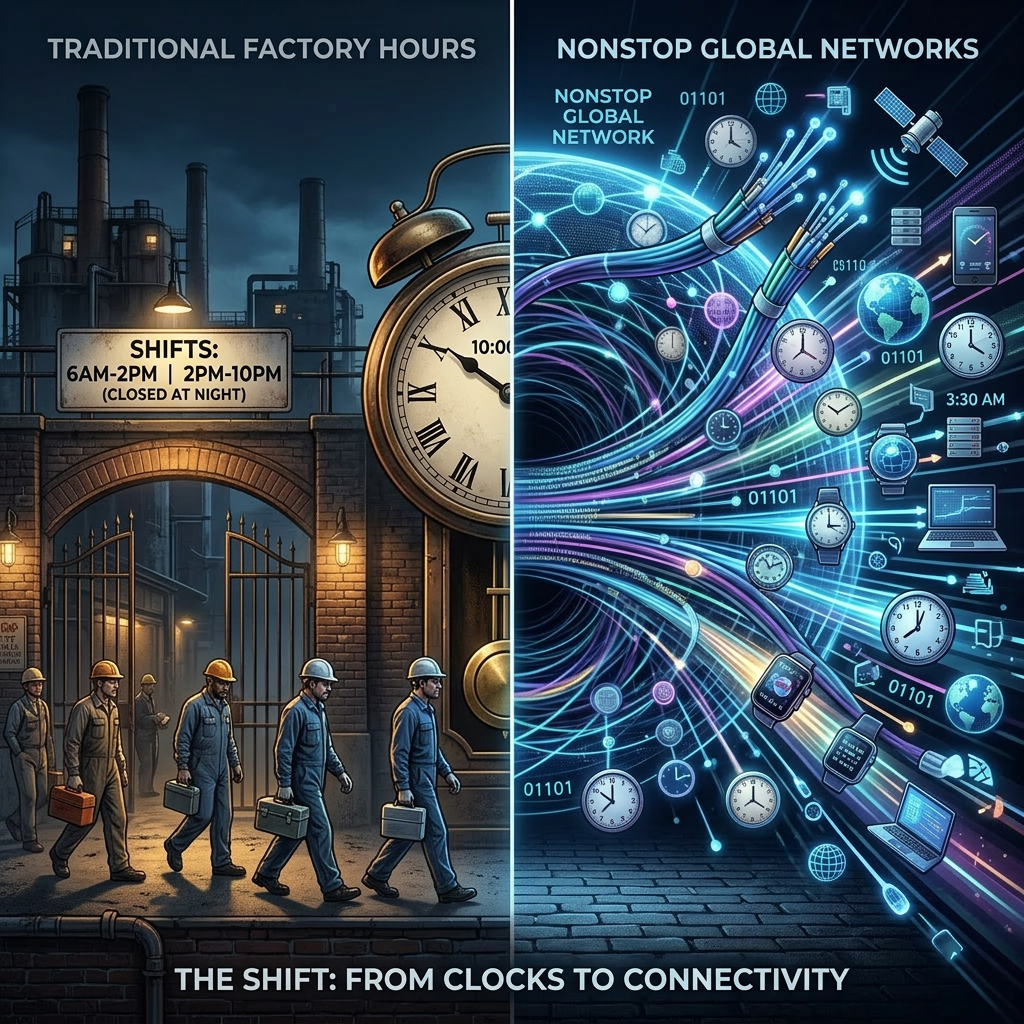
Modern society increasingly operates without interruption. Communication flows continuously across digital platforms, institutions process information in real time, financial systems function twenty four hours a day, and individuals remain connected through devices that rarely leave their reach. Work, communication, consumption, entertainment, and governance are now organized through infrastructures designed for constant activity and permanent responsiveness.
The expectation of continuity has become normalized.
Messages are expected to receive immediate responses, notifications arrive continuously, and digital systems encourage constant engagement through endless streams of information and interaction. In many environments, slowing down is no longer perceived as ordinary. It appears inefficient, unproductive, or even socially absent.
This transformation is not merely technological.
It represents a broader shift in how contemporary systems organize time, attention, labor, and human experience itself. Increasingly, people live within systems that never pause.
The consequences are profound because human beings are not designed for continuous acceleration and permanent responsiveness.
The Rise of Continuous Systems
Industrial society was structured around clearer temporal boundaries.
Workplaces had opening and closing hours, communication was limited by geography and infrastructure, and periods of rest were more visibly separated from periods of labor. Digital systems have significantly weakened these distinctions.
Today, communication infrastructures operate continuously across global networks. Social media platforms update endlessly, online commerce never closes, and institutional systems increasingly expect real time responsiveness from both workers and citizens.
Jonathan Crary (2013) argues that contemporary capitalism increasingly seeks to eliminate interruption, rest, and inactivity in favor of continuous operation. Digital infrastructures support an economic and cultural environment where activity becomes permanent rather than cyclical.
This transformation changes how individuals experience everyday life.
Time becomes compressed, fragmented, and continuously occupied.
Connectivity and Permanent Availability
One of the defining characteristics of system driven societies is permanent availability.
Mobile devices ensure that individuals remain reachable almost constantly. Work related communication extends beyond formal working hours, social interaction continues across digital platforms late into the night, and institutional expectations increasingly assume uninterrupted connectivity.
What once appeared exceptional has become normalized.
The absence of response may now be interpreted as disengagement, inefficiency, or social withdrawal. People increasingly feel pressure to remain visible and responsive within systems organized around continuous interaction.
Sherry Turkle (2011) argues that digital communication technologies reshape not only how individuals connect, but also how they experience presence and absence. Constant connectivity creates environments where disconnection itself becomes difficult.
The result is a subtle but persistent form of social acceleration.
Individuals remain connected not necessarily because they choose continuous engagement freely, but because systems increasingly require it.
Attention Under Continuous Demand
Systems that never pause also place continuous demands on human attention.
Notifications, updates, algorithmic feeds, and recommendation systems compete constantly for cognitive engagement. Digital platforms are designed to maximize interaction because engagement generates behavioral data and economic value.
Herbert Simon (1971) warned that an abundance of information creates a scarcity of attention. In contemporary digital society, this scarcity has become central to everyday life.
Human attention is continuously fragmented across competing informational streams.
Nicholas Carr (2010) argues that constant exposure to fragmented digital environments weakens the capacity for deep concentration and reflective thought. Attention shifts rapidly between tasks, messages, and stimuli, reducing opportunities for sustained engagement and contemplation.
The consequence is not simply distraction.
It is the restructuring of cognition itself within environments optimized for perpetual responsiveness.
The Disappearance of Rest
Rest once functioned as a meaningful interruption within social life.
Periods of pause allowed individuals to recover physically, reflect mentally, and maintain boundaries between labor and personal existence. Systems that never pause increasingly erode these interruptions.
Digital infrastructures extend work into domestic spaces through emails, messaging platforms, and remote connectivity. Social media transforms leisure into continuous visibility and interaction. Streaming platforms eliminate temporal limits on entertainment consumption.
Crary (2013) argues that contemporary digital capitalism treats uninterrupted activity as economically valuable because inactive time produces neither engagement nor measurable productivity.
Rest therefore becomes increasingly difficult to protect.
Even moments traditionally associated with pause become occupied by informational consumption and digital interaction. Silence and inactivity begin to feel unfamiliar within environments organized around continuous stimulation.
The result is a society where individuals remain active even when they are supposedly resting.
Automation and Institutional Speed
Institutions themselves increasingly operate according to accelerated temporal logic.
Governments process administrative data continuously, corporations rely on real time analytics, and algorithmic systems generate decisions instantly across financial markets, logistics networks, and digital communication infrastructures.
Automation contributes significantly to this acceleration.
Machine systems process information at speeds impossible for human institutions alone. Decisions once requiring deliberation may now occur automatically through predictive systems optimized for efficiency and responsiveness.
Hartmut Rosa (2013) describes this broader condition as social acceleration, where technological speed transforms institutional expectations and social rhythms simultaneously.
As systems accelerate, individuals are expected to adapt accordingly.
However, human judgment, ethical reflection, and meaningful understanding often require slowness. Institutions operating continuously may prioritize rapid response over contextual interpretation and deliberative consideration.
Efficiency increases while opportunities for reflection diminish.
Psychological Consequences of Continuous Systems
Living within systems that never pause produces significant psychological consequences.
Continuous responsiveness can generate fatigue, anxiety, and cognitive exhaustion. Individuals may feel unable to disconnect because social, economic, and professional participation increasingly depends on remaining continuously engaged.
Byung-Chul Han (2015) argues that contemporary societies increasingly produce forms of self exploitation where individuals internalize pressures toward constant productivity and optimization.
Unlike older forms of discipline imposed externally, modern systems encourage individuals to monitor and intensify their own activity continuously.
This creates a paradox.
People experience themselves as free participants within digital systems while simultaneously feeling trapped by expectations of uninterrupted engagement and performance.
Exhaustion becomes normalized.
Human Relationships in Accelerated Environments
Systems that never pause also reshape social relationships.
Communication becomes faster but not necessarily deeper. Conversations compete with notifications and fragmented attention. Presence becomes divided between physical environments and digital interaction.
Turkle (2011) notes that digital communication technologies often create forms of connection that are frequent yet emotionally thin. Individuals remain constantly reachable while experiencing increasing difficulty sustaining uninterrupted human attention.
Meaningful relationships often depend on patience, listening, silence, and sustained presence.
Accelerated systems weaken these conditions by organizing interaction around speed, visibility, and responsiveness.
The issue is therefore not only technological distraction.
It is the gradual transformation of how human connection itself is experienced.
The Politics of Continuous Activity
Systems that never pause are not politically neutral.
Continuous connectivity and engagement benefit institutions capable of extracting economic value from behavioral activity. Social media platforms profit from attention, corporations depend on constant productivity, and digital economies rely on uninterrupted data generation.
Shoshana Zuboff (2019) argues that surveillance capitalism depends on the continuous extraction of behavioral data in order to predict and shape future actions.
Continuous activity therefore becomes economically valuable.
The more individuals remain connected, engaged, and responsive, the more data becomes available for analysis and monetization. Human behavior itself becomes integrated into infrastructures optimized for perpetual interaction.
This creates asymmetrical relationships of power.
Institutions controlling digital systems possess increasing influence over how individuals experience time, attention, and social participation.
Human Agency and the Need for Pause
Human beings require interruption.
Reflection, ethical judgment, creativity, and emotional recovery depend partly on the existence of pauses within social life. Continuous acceleration weakens opportunities for contemplation because individuals remain immersed within systems demanding constant responsiveness.
Hannah Arendt (1958) emphasized the importance of reflective thought and political judgment within human existence. Human agency depends not only on action, but also on the ability to step back, interpret experience, and reconsider the conditions shaping social life.
Systems that never pause make this increasingly difficult.
Without interruption, individuals risk becoming reactive participants within technological environments rather than reflective actors capable of independent judgment.
The ability to disconnect therefore becomes more than a personal preference.
It becomes a condition for preserving autonomy itself.
A Data Justice Perspective
A data justice perspective helps explain why continuous systems matter socially and politically.
Linnet Taylor (2017) argues that digital systems should be evaluated according to fairness in representation, visibility, and treatment rather than technical efficiency alone.
From this perspective, continuous systems are not merely technological conveniences.
They are infrastructures shaping how people experience time, labor, attention, and participation within digital society.
Representation concerns whose lives become organized through expectations of constant responsiveness.
Distribution examines how the burdens of acceleration and digital exhaustion are allocated across populations.
Governance focuses on who controls infrastructures designed around continuous engagement and how accountability can be maintained.
The right to pause therefore becomes connected to broader questions of autonomy, dignity, and social justice.
Toward More Human Temporalities
Addressing the pressures of continuous systems requires rethinking how digital infrastructures are designed and governed.
At the institutional level, organizations should reconsider expectations surrounding permanent availability and uninterrupted responsiveness.
At the technical level, systems should support human well being rather than maximizing engagement and acceleration endlessly.
At the societal level, protecting spaces for reflection, rest, and disconnection becomes increasingly important within environments organized around continuous activity.
Most importantly, societies must recognize that human beings are not machines.
People require limits, pauses, and temporal boundaries in order to think, relate, recover, and live meaningfully.
Conclusion
Contemporary society increasingly operates through systems that never pause.
Digital infrastructures organize communication, labor, governance, and social interaction around continuous activity and permanent responsiveness. While these systems provide efficiency and connectivity, they also fragment attention, erode rest, accelerate institutional life, and intensify psychological exhaustion.
The challenge is not simply technological.
It is understanding how societies preserve human autonomy, reflection, and meaningful existence within environments optimized for uninterrupted engagement.
Living well in digital society requires more than remaining continuously connected.
It requires protecting the human capacity to pause.
References
Arendt, H. (1958). The Human Condition. University of Chicago Press.
Carr, N. (2010). The Shallows: What the Internet Is Doing to Our Brains. W. W. Norton & Company.
Crary, J. (2013). 24/7: Late Capitalism and the Ends of Sleep. Verso.
Han, B. C. (2015). The Burnout Society. Stanford University Press.
Rosa, H. (2013). Social Acceleration: A New Theory of Modernity. Columbia University Press.
Simon, H. A. (1971). “Designing Organizations for an Information Rich World.” In Computers, Communications, and the Public Interest. Johns Hopkins Press.
Taylor, L. (2017). “What Is Data Justice? The Case for Connecting Digital Rights and Freedoms Globally.” Big Data & Society, 4(2).
Turkle, S. (2011). Alone Together: Why We Expect More from Technology and Less from Each Other. Basic Books.
Zuboff, S. (2019). The Age of Surveillance Capitalism. PublicAffairs.


Leave a Reply