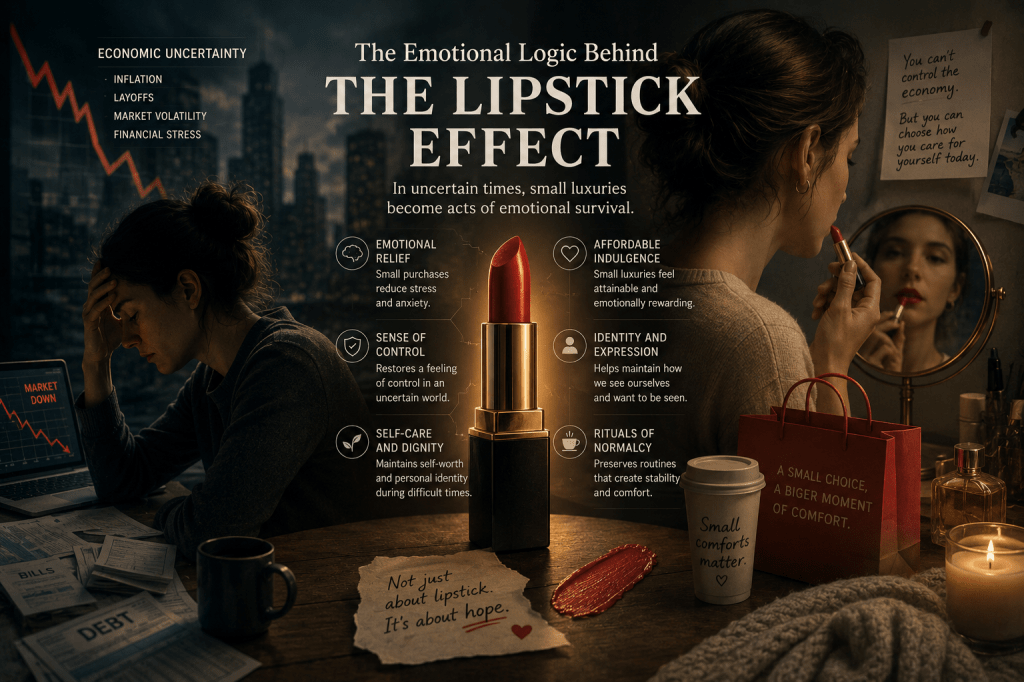
Economic crises often change how people think about consumption. During periods of uncertainty, households may reduce major spending, delay long term purchases, and become more cautious about financial decisions. Large investments feel risky when employment, inflation, or economic stability appear uncertain. Yet despite this caution, consumption rarely disappears entirely.
Instead, it changes form.
People may stop buying houses, luxury cars, or expensive vacations, while continuing to purchase smaller items associated with comfort, confidence, or emotional satisfaction. Cosmetics, affordable fashion, premium coffee, skincare products, and other relatively accessible luxuries often remain surprisingly resilient during difficult economic periods.
This phenomenon has become widely known as the “lipstick effect.”
At first glance, the lipstick effect appears economically irrational. Why would people continue buying nonessential items during periods of financial anxiety? However, the behavior becomes more understandable when viewed not only through economics, but also through psychology, emotion, and social meaning.
The lipstick effect is not simply about consumption.
It reflects the emotional logic of living under uncertainty.
Understanding the Lipstick Effect
The term “lipstick effect” became popular after observations that cosmetic sales sometimes remained stable or even increased during economic downturns. Leonard Lauder of Estée Lauder famously discussed the idea following the economic slowdown after the September 11 attacks and during periods of recession.
The broader concept, however, extends beyond cosmetics alone.
During periods of financial instability, consumers often shift from large aspirational purchases toward smaller and more emotionally manageable forms of consumption. Instead of abandoning pleasure entirely, people seek affordable symbols of comfort, dignity, or self reward.
This behavior reflects an important psychological reality.
Human beings do not consume only for material utility. Consumption also carries emotional, symbolic, and social meaning.
In uncertain times, small luxuries can become forms of emotional stabilization.
Economic Anxiety and Psychological Control
One reason the lipstick effect emerges is because uncertainty creates feelings of lost control.
Economic crises introduce unpredictability into everyday life. Inflation, layoffs, unstable markets, and declining purchasing power generate anxiety about the future. People may feel increasingly unable to influence broader economic conditions shaping their lives.
In these situations, small purchases can provide a temporary sense of agency.
Buying an affordable luxury item allows individuals to retain some control over personal experience even when larger aspects of economic life feel unstable. A premium coffee, a skincare product, or a new lipstick may appear financially insignificant compared to larger economic concerns, yet psychologically they can represent continuity, self care, and personal choice.
Daniel Kahneman and Amos Tversky’s work on behavioral economics demonstrates that human decision making is deeply influenced by emotional perception and psychological framing rather than purely rational calculation (Kahneman, 2011).
Consumption therefore often becomes emotional behavior as much as economic behavior.
The lipstick effect reflects how people attempt to preserve emotional balance within unstable environments.
Small Luxuries and Emotional Survival
Small luxuries matter partly because they offer emotional reassurance.
During difficult periods, people often seek routines or experiences that preserve a sense of normality and dignity. Minor forms of consumption may function symbolically as reminders that pleasure, beauty, and personal identity still remain accessible despite broader instability.
This dynamic became visible during the global COVID-19 pandemic.
While many households reduced travel and large discretionary spending, sales in categories such as skincare, home comfort products, streaming services, and affordable self care items remained relatively strong in many markets. Consumers redirected spending toward smaller forms of emotional comfort compatible with uncertain conditions.
The behavior was not simply materialistic.
It reflected attempts to cope psychologically with stress, isolation, and unpredictability.
Consumption became partially therapeutic.
Real Example: Lipstick Sales During Economic Downturns
The lipstick effect gained renewed attention during the 2008 global financial crisis.
While many sectors experienced severe decline, some cosmetic and affordable luxury brands reported relatively stable performance. Consumers reduced large expenditures but continued purchasing smaller premium products that remained psychologically attainable.
Research from Euromonitor and analyses within consumer behavior studies observed similar patterns across multiple downturns. Consumers often shifted spending away from high commitment purchases toward smaller indulgences carrying emotional and symbolic value.
Importantly, this did not mean consumers ignored economic realities.
Rather, they adapted consumption strategically.
Large luxuries became difficult to justify financially, while smaller luxuries remained emotionally defensible because they provided temporary comfort without threatening household survival directly.
Consumption as Symbolic Identity
The lipstick effect also reveals how consumption relates to identity.
People do not only purchase products because they need them materially. They also consume symbols connected to confidence, self presentation, aspiration, and social belonging.
Pierre Bourdieu (1984) argued that consumption patterns are closely tied to social identity and cultural meaning. Products communicate status, taste, emotional aspiration, and self perception.
During periods of uncertainty, maintaining these symbolic dimensions can become psychologically important.
A small luxury purchase may function as reassurance that one’s personal identity remains intact despite economic instability. Individuals may continue investing in appearance, grooming, or lifestyle rituals because these practices support emotional continuity and self esteem.
The emotional logic behind the lipstick effect is therefore deeply connected to human dignity and social identity.
The Gendered Dimensions of the Lipstick Effect
The lipstick effect is also connected to gendered expectations within society.
Historically, cosmetics and appearance related products have been associated disproportionately with women, leading some discussions of the lipstick effect to focus narrowly on female consumer behavior. However, contemporary consumption patterns suggest broader emotional dynamics extending across genders.
Today, similar behaviors appear in categories such as premium coffee, gaming, sneakers, skincare, fitness products, technology accessories, and other forms of accessible lifestyle consumption.
The broader pattern is not fundamentally about lipstick itself.
It is about emotional compensation during periods where larger aspirations feel economically constrained.
Nevertheless, gender expectations remain relevant because appearance and self presentation continue to carry unequal social pressures across societies.
The emotional significance of small luxuries therefore cannot be separated entirely from broader cultural expectations regarding identity and visibility.
Modern Capitalism and Emotional Consumption
The lipstick effect also reflects how modern economies increasingly operate through emotional consumption.
Contemporary advertising and digital platforms rarely market products purely through practical utility alone. Consumption is increasingly associated with self care, empowerment, comfort, confidence, and emotional well being.
Eva Illouz (2007) argues that modern capitalism increasingly integrates emotional life into consumer culture, transforming feelings themselves into economic territory.
In this environment, small luxury consumption becomes psychologically meaningful because markets actively position products as emotional solutions.
A skincare product promises confidence. Premium coffee symbolizes self reward. Fashion becomes associated with self expression and resilience.
Consumption therefore becomes intertwined with emotional management.
The lipstick effect reveals not only economic adaptation, but also the emotional structure of consumer society itself.
Social Media and the Intensification of Desire
Digital culture intensifies these dynamics further.
Social media platforms continuously expose individuals to curated lifestyles, beauty standards, and aspirational consumption patterns. Even during economic hardship, individuals remain immersed in environments encouraging visibility, self presentation, and symbolic consumption.
Shoshana Zuboff (2019) argues that digital economies increasingly rely on behavioral influence and emotional engagement to sustain consumer activity.
This creates tension during uncertain economic periods.
People experience financial pressure while simultaneously remaining exposed to digital cultures of aspiration and visibility. Small luxuries may therefore function as accessible ways to participate symbolically in aspirational lifestyles that larger economic realities no longer fully permit.
The lipstick effect becomes partly digital as well as economic.
The Limits of Rational Economic Models
Traditional economic models often assume consumers behave rationally according to utility maximization and financial optimization.
The lipstick effect complicates these assumptions.
Human beings do not respond to uncertainty solely by minimizing all nonessential spending. Emotional resilience, symbolic identity, and psychological coping also influence economic behavior.
Behavioral economics increasingly recognizes that emotions, cognitive biases, and social context shape financial decisions significantly.
People seek not only survival, but also emotional continuity.
The lipstick effect therefore reveals something important about human nature.
Even during uncertainty, individuals continue searching for moments of reassurance, beauty, pleasure, and control.
A Sociological Perspective on Small Comforts
From a sociological perspective, small luxuries function partly as stabilizing rituals within unstable environments.
Daily routines involving coffee, skincare, fashion, or entertainment can provide structure and familiarity during periods of broader social anxiety. These practices may appear economically minor while carrying significant emotional meaning.
Zygmunt Bauman (2007) argues that contemporary societies are increasingly characterized by insecurity and fluidity, where individuals must continuously adapt to changing economic and social conditions.
Within such environments, small comforts become psychologically important because they create temporary experiences of stability and familiarity.
The emotional logic behind the lipstick effect is therefore connected not only to economics, but also to the search for emotional grounding within uncertain modern life.
Conclusion
The lipstick effect reveals that consumption is never purely economic.
During periods of uncertainty, people often continue purchasing small luxuries not because they ignore financial realities, but because these purchases provide emotional reassurance, symbolic continuity, and temporary feelings of control within unstable environments.
The phenomenon reflects a deeper truth about modern society.
Human beings seek more than material survival alone. They also seek dignity, identity, comfort, and emotional stability, especially during moments of crisis and uncertainty.
Understanding the lipstick effect therefore requires moving beyond simplistic assumptions about irrational spending or superficial consumerism.
Small luxuries matter because they help people preserve fragments of normality and selfhood when larger structures of economic certainty begin to weaken.
In uncertain times, consumption becomes emotional logic.
And sometimes, a small comfort represents far more than the product itself.
References
Bauman, Z. (2007). Liquid Times: Living in an Age of Uncertainty. Polity Press.
Bourdieu, P. (1984). Distinction: A Social Critique of the Judgement of Taste. Harvard University Press.
Illouz, E. (2007). Cold Intimacies: The Making of Emotional Capitalism. Polity Press.
Kahneman, D. (2011). Thinking, Fast and Slow. Farrar, Straus and Giroux.
Zuboff, S. (2019). The Age of Surveillance Capitalism. PublicAffairs.


Leave a Reply