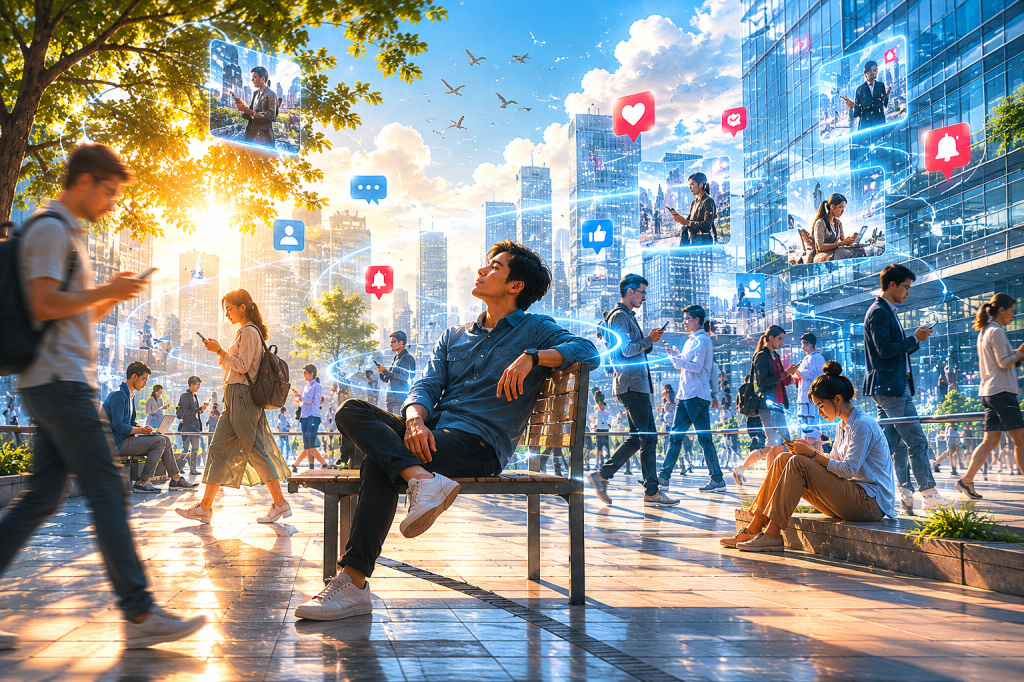
Modern society increasingly operates through systems that demand attention continuously. Smartphones vibrate with notifications throughout the day, social media platforms compete relentlessly for visibility, workplaces expect constant responsiveness, and digital systems monitor interaction in real time. Across everyday life, individuals are surrounded by infrastructures designed not merely to communicate information, but to capture and sustain attention itself.
Attention has become one of the most valuable resources of contemporary society.
Technology companies compete for it, institutions rely on it, and digital economies are built around extracting and monetizing it. Human focus, once treated as a personal cognitive capacity, is now deeply embedded within economic systems and technological design.
Yet living under constant attention carries significant consequences.
The modern individual is no longer simply paying attention to the world. Increasingly, the world is also paying attention to the individual. Platforms monitor behavior, audiences observe visibility, workplaces measure productivity, and algorithms track engagement continuously. Human life unfolds within environments where observation, responsiveness, and visibility become permanent conditions.
This creates a profound transformation in how people experience thought, emotion, work, and social existence itself.
Attention as Economic Infrastructure
The modern digital economy depends heavily on attention.
Social media platforms, streaming services, advertising systems, and digital applications are designed to maximize engagement because engagement generates valuable behavioral data and commercial revenue. The longer individuals remain active within digital systems, the more information platforms can collect and monetize.
Shoshana Zuboff (2019) argues that surveillance capitalism increasingly relies on extracting behavioral data in order to predict and influence future action. Within this system, attention becomes economically productive.
Human focus therefore transforms into a commercial resource.
Notifications, personalized feeds, autoplay systems, and algorithmic recommendations are not merely technological conveniences. They are mechanisms designed to sustain interaction continuously and minimize disengagement.
The result is an environment where individuals rarely experience uninterrupted mental space.
The Fragmentation of Attention
Living under constant attention fragments cognitive life.
Individuals move continuously between messages, notifications, social media updates, work communication, entertainment platforms, and digital information streams. Attention becomes divided across multiple simultaneous demands.
Nicholas Carr (2010), in The Shallows, argues that constant exposure to fragmented digital environments weakens the capacity for deep concentration and sustained reflection. Human cognition gradually adapts to rapid informational switching rather than prolonged focus.
This transformation affects more than productivity.
It changes how people think.
Deep attention allows reflection, creativity, emotional processing, and critical judgment. Fragmented attention encourages reactivity instead of contemplation. People increasingly respond immediately rather than thinking slowly.
The pressure of continuous attention therefore reshapes not only behavior, but consciousness itself.
Visibility and the Feeling of Being Observed
Modern life also creates the experience of permanent visibility.
Social media platforms encourage individuals to remain publicly active through posts, reactions, stories, photographs, and opinions. Professional environments increasingly rely on digital monitoring systems capable of tracking responsiveness and productivity in real time.
Michel Foucault (1977) argued that modern systems of power increasingly operate through visibility and observation rather than direct force alone. People regulate themselves partly because they know they may be observed.
Digital society intensifies this dynamic significantly.
Individuals become aware that their behavior, appearance, opinions, and activity remain continuously visible to audiences, institutions, and algorithmic systems. This awareness creates subtle psychological pressure because people increasingly manage themselves according to anticipated observation.
The result is emotional fatigue.
Human beings are not psychologically designed to exist under continuous social visibility without rest.
Real Example: Workplace Monitoring Technologies
One increasingly visible example of life under constant attention appears in modern workplaces through productivity monitoring technologies.
Many organizations now use software capable of tracking keystrokes, application usage, response times, meeting participation, and digital activity patterns. These systems are often justified through efficiency, accountability, and remote work coordination.
However, employees frequently report increased stress and psychological exhaustion within environments of continuous monitoring.
Workers may feel pressure to appear constantly active, immediately responsive, and visibly productive even during moments requiring rest or deeper concentration. Attention shifts away from meaningful work itself toward maintaining measurable visibility within monitoring systems.
This creates a condition where professional life becomes performative.
People work while simultaneously managing the appearance of working.
Social Media and Performed Attention
Social media intensifies attention pressure further by transforming interaction into performance.
Platforms reward visibility through likes, comments, shares, and engagement metrics. Individuals become conscious not only of what they communicate, but also of how communication performs publicly.
Erving Goffman (1959) described social life as partially theatrical long before digital platforms existed. However, social media expands performative behavior into continuous public visibility supported by measurable feedback systems.
Attention becomes social validation.
People increasingly evaluate themselves according to responsiveness, relevance, and audience engagement. Silence or absence may feel socially risky because visibility becomes associated with legitimacy and belonging.
This creates emotional instability because social attention is inherently unpredictable and temporary.
The individual remains psychologically exposed to continuous evaluation through digital interaction.
The Loss of Mental Privacy
One of the less visible consequences of constant attention is the erosion of mental privacy.
Historically, human beings experienced more moments free from interruption and observation. Solitude, boredom, silence, and uninterrupted thought were ordinary parts of life. Contemporary digital systems increasingly reduce these spaces.
Jonathan Crary (2013) argues that modern capitalism continuously seeks to eliminate inactivity and interruption in favor of permanent engagement.
This affects emotional and intellectual life deeply.
Without mental privacy, individuals struggle to reflect, recover emotionally, or think independently from external stimulation. Attention remains externally directed rather than internally grounded.
People become continuously reachable while losing opportunities to disengage psychologically from systems demanding attention.
Emotional Consequences of Constant Attention
Living under continuous attention creates emotional strain.
Individuals often experience anxiety, overstimulation, irritability, and exhaustion without fully recognizing the structural conditions producing these emotions. Constant visibility and responsiveness require ongoing psychological energy.
Byung-Chul Han (2015) argues that contemporary society increasingly produces burnout because individuals internalize pressure toward continuous performance and self optimization.
Attention itself becomes labor.
People monitor messages, manage visibility, maintain online presence, and remain emotionally available across multiple systems simultaneously. Even leisure becomes partially performative through digital sharing and social interaction.
The exhaustion is often quiet because continuous attention has become normalized socially.
Many individuals no longer remember what uninterrupted psychological space feels like.
Attention and Human Relationships
Constant attention also changes relationships.
People communicate more frequently while often listening less deeply. Conversations compete against notifications and fragmented focus. Human interaction increasingly occurs within environments shaped by divided attention and digital interruption.
Sherry Turkle (2011) argues that digital communication technologies may increase connection while weakening the quality of human presence.
Attention is central to emotional intimacy because meaningful relationships depend on listening, patience, and sustained engagement. Fragmented attention weakens these experiences gradually.
The issue is not only distraction.
It is the transformation of human presence itself.
People may remain physically together while mentally dispersed across digital systems demanding continuous awareness.
The Political Nature of Attention
Attention is not merely personal or psychological.
It is political and economic.
Institutions capable of directing collective attention possess significant influence over public perception, emotional life, and social behavior. Platforms determine visibility algorithmically, news cycles accelerate emotional reaction, and digital systems shape what individuals notice continuously.
Herbert Simon (1971) warned that an abundance of information creates scarcity of attention. In digital society, this scarcity becomes central to governance, economics, and social life.
Human attention increasingly functions as infrastructure supporting technological systems and commercial platforms.
The question therefore becomes not only how individuals manage attention, but who benefits from environments designed to fragment and capture it continuously.
A Data Justice Perspective
A data justice perspective helps illuminate the deeper implications of life under constant attention.
Linnet Taylor (2017) argues that digital systems should be evaluated according to fairness, visibility, and treatment rather than technical efficiency alone.
Continuous attention systems affect individuals unevenly. Some populations face intensified surveillance, greater performance pressure, or increased algorithmic visibility compared to others.
At the same time, people increasingly become data subjects whose behavior is continuously monitored, analyzed, and monetized through systems they only partially understand.
The burden of constant attention is therefore structural rather than purely individual.
It reflects broader transformations in how societies organize visibility, labor, and human interaction.
Reclaiming Attention
Addressing the pressures of constant attention requires more than personal productivity strategies alone.
At the technological level, digital systems should prioritize human well being rather than maximizing engagement endlessly.
At the institutional level, workplaces and organizations must reconsider cultures of permanent responsiveness and continuous visibility.
At the societal level, greater value must be placed on reflection, silence, and uninterrupted thought as conditions necessary for emotional and intellectual health.
Most importantly, societies must recognize that attention is not an infinite resource.
Human beings require spaces free from constant observation and interruption in order to think, recover, and remain psychologically grounded.
Conclusion
Modern life increasingly unfolds under constant attention.
Digital systems, workplaces, social media platforms, and institutional infrastructures continuously compete for human focus while simultaneously monitoring behavior and visibility. Attention has become fragmented, commercialized, and deeply integrated into the structure of contemporary society.
The consequences are emotional, cognitive, and social.
People experience overstimulation, exhaustion, and diminished mental privacy while struggling to preserve meaningful forms of concentration and human presence.
The challenge is not simply technological.
It is learning how to protect human attention from systems designed to capture it continuously.
Because attention is more than a cognitive resource.
It is part of what allows human beings to think deeply, connect meaningfully, and remain fully present within their own lives.
References
Carr, N. (2010). The Shallows: What the Internet Is Doing to Our Brains. W. W. Norton & Company.
Crary, J. (2013). 24/7: Late Capitalism and the Ends of Sleep. Verso.
Foucault, M. (1977). Discipline and Punish: The Birth of the Prison. Pantheon Books.
Goffman, E. (1959). The Presentation of Self in Everyday Life. Anchor Books.
Han, B. C. (2015). The Burnout Society. Stanford University Press.
Simon, H. A. (1971). “Designing Organizations for an Information Rich World.” In Computers, Communications, and the Public Interest. Johns Hopkins Press.
Taylor, L. (2017). “What Is Data Justice? The Case for Connecting Digital Rights and Freedoms Globally.” Big Data & Society, 4(2).
Turkle, S. (2011). Alone Together: Why We Expect More from Technology and Less from Each Other. Basic Books.
Zuboff, S. (2019). The Age of Surveillance Capitalism. PublicAffairs.


Leave a Reply