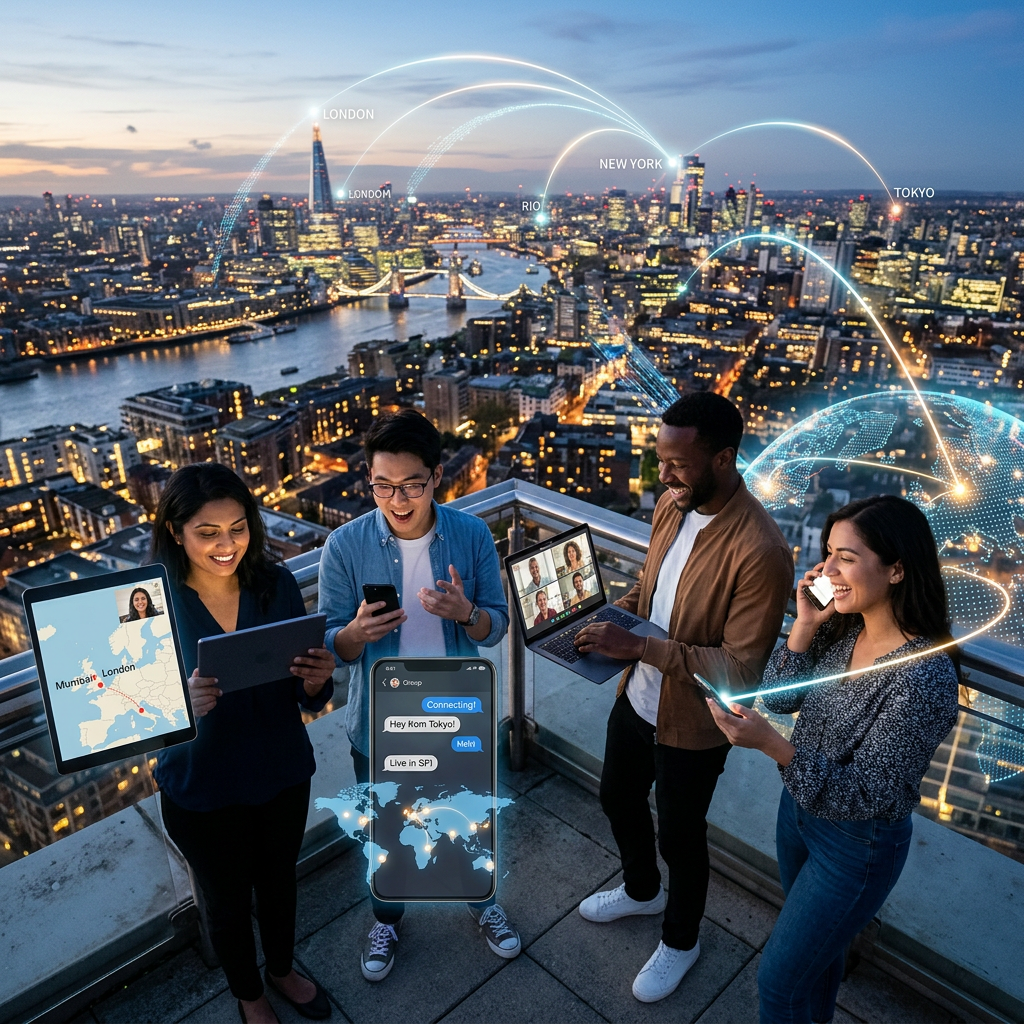
Human history has never witnessed a period of connectivity quite like the present.
Messages travel across continents in seconds. News from the other side of the world appears instantly on mobile phones. Families separated by thousands of kilometers can see one another through video calls. Businesses coordinate global operations in real time, while artificial intelligence enables people to access knowledge with unprecedented speed.
The world has become deeply connected.
Distance matters less than it once did.
Information flows continuously across borders, languages, and institutions, creating opportunities for cooperation, innovation, and learning that previous generations could scarcely imagine.
Yet alongside these remarkable achievements, another transformation has quietly emerged.
Many people feel less certain than ever before.
They question the reliability of information. They struggle to distinguish expertise from opinion. They hesitate before trusting images, videos, institutions, and even their own judgments. Despite living in an age of extraordinary access to knowledge, certainty often feels increasingly difficult to attain.
This paradox defines much of contemporary life.
The more connected society becomes, the less certain many people feel.
Understanding this paradox requires looking beyond technology itself toward the changing nature of knowledge, trust, and human judgment.
Connectivity Is Not the Same as Understanding
Modern technology has dramatically expanded access to information.
Search engines answer questions instantly.
Artificial intelligence summarizes complex topics.
Social media platforms expose users to perspectives from around the globe.
Educational resources once limited to universities now reach millions of people online.
These developments represent significant progress.
Access to knowledge has become more democratic than at any previous time in history.
However, information alone does not produce understanding.
Understanding requires interpretation.
It requires context.
It requires the ability to distinguish between facts, assumptions, evidence, and opinion.
Digital connectivity delivers information rapidly.
Human understanding develops much more slowly.
The Collapse of Shared Reality
For much of the twentieth century, many societies relied on relatively common sources of information.
Newspapers, public broadcasters, universities, and established institutions helped create shared reference points through which public debate occurred. These systems were imperfect and often reflected their own biases, yet they contributed to a degree of common understanding.
Digital platforms have transformed this landscape.
Algorithms personalize information according to previous behavior.
News feeds differ from person to person.
Search results vary depending on location, history, and user profiles.
Artificial intelligence increasingly generates customized responses for individual users.
The consequence is subtle.
People no longer experience exactly the same informational world.
Eli Pariser (2011) described this phenomenon as the “filter bubble,” where personalization gradually narrows exposure to unfamiliar perspectives.
Connectivity increases.
Shared reality fragments.
Real Example: One Event, Many Realities
Consider a major global event.
Within minutes, millions of people encounter news through different channels. Some read professional journalism. Others receive information through social media. Many encounter edited clips, commentary, memes, AI-generated summaries, or emotionally charged posts that emphasize particular interpretations.
Everyone is connected to the same event.
Yet they experience entirely different versions of it.
Some conclude the situation is improving.
Others believe it is deteriorating.
Both groups often feel equally confident because each encounters information that reinforces existing expectations.
The issue is no longer access.
It is interpretation.
Too Much Information, Too Little Confidence
Herbert Simon (1971) famously observed that an abundance of information creates a scarcity of attention.
Today, another consequence has become increasingly visible.
An abundance of information can also produce uncertainty.
When individuals encounter endless streams of competing claims, expert opinions, contradictory evidence, and algorithmically amplified content, confidence becomes difficult to maintain.
Rather than resolving uncertainty, additional information sometimes intensifies it.
People continue searching because they never feel completely informed.
Knowledge becomes an endless process of updating rather than arriving.
Artificial Intelligence and the Multiplication of Answers
Artificial intelligence introduces another dimension to this transformation.
AI systems can generate explanations, summarize research, compare perspectives, and answer complex questions within seconds. These capabilities dramatically expand access to knowledge.
At the same time, they also multiply interpretation.
Different AI systems may produce different emphases.
Different prompts generate different responses.
Different training data shape different conclusions.
The result is not necessarily confusion.
It is plurality.
Plurality enriches understanding when accompanied by critical thinking.
Without it, plurality may increase uncertainty because individuals encounter many plausible answers without clear criteria for choosing among them.
Trust in an Age of Infinite Choice
Trust has become one of the most valuable yet fragile resources of contemporary society.
People choose between countless news sources, experts, influencers, institutions, and digital communities.
Choice creates freedom.
It also creates responsibility.
Individuals must increasingly determine whom to trust without relying upon universally accepted authorities.
Francis Fukuyama (1995) argues that trust functions as a form of social capital enabling cooperation across complex societies.
When trust becomes fragmented, cooperation often becomes more difficult.
People begin questioning not only information but also the institutions responsible for producing it.
Connectivity expands networks.
It does not automatically strengthen trust.
Certainty and the Human Mind
Human beings naturally seek certainty.
Uncertainty creates discomfort because it complicates decision making.
Psychologist Daniel Kahneman (2011) demonstrates that people often rely on mental shortcuts to reduce complexity when confronting uncertain environments.
Digital societies challenge these tendencies.
New information appears continuously.
Scientific knowledge evolves.
Political events change rapidly.
Artificial intelligence accelerates the production of content faster than individuals can evaluate it.
The desire for certainty remains.
The conditions supporting certainty become increasingly unstable.
Living with Uncertainty
Perhaps the challenge is not restoring absolute certainty.
Perhaps it is learning to live wisely without it.
History suggests that knowledge has always evolved.
Scientific understanding changes.
Social values develop.
Institutions adapt.
Technology transforms expectations.
The difference today lies in the speed at which these changes become visible.
Connectivity reveals uncertainty that previously remained hidden.
Recognizing complexity should not necessarily weaken confidence.
It may strengthen intellectual humility.
A Data Justice Perspective
A data justice perspective offers another way to understand contemporary uncertainty.
Linnet Taylor (2017) argues that digital systems should be evaluated according to representation, distribution, and governance.
Algorithms determine which information receives visibility.
Recommendation systems shape public attention.
Artificial intelligence increasingly mediates access to knowledge.
Questions therefore become unavoidable.
Who determines which information appears?
Whose voices become amplified?
Whose perspectives remain invisible?
Uncertainty is not always a consequence of insufficient information.
Sometimes it reflects unequal structures governing information itself.
Choosing Understanding Over Certainty
The future may require a different relationship with knowledge.
Instead of seeking absolute certainty, societies may increasingly value thoughtful understanding.
Understanding acknowledges complexity.
It welcomes evidence.
It remains open to revision.
It distinguishes confidence from certainty.
Living in connected societies requires more than digital literacy.
It requires intellectual patience.
The willingness to pause before sharing.
The discipline to verify before believing.
The humility to recognize that even abundant information does not eliminate the need for judgment.
Conclusion
Modern society has achieved extraordinary connectivity.
People communicate across continents instantly, access vast libraries of knowledge through mobile devices, and collaborate with artificial intelligence in ways unimaginable only decades ago.
Yet connectivity has not eliminated uncertainty.
Instead, it has revealed the complexity of a world where information is abundant, perspectives are diverse, and certainty is increasingly difficult to sustain.
This is not necessarily a crisis.
It may be an invitation.
An invitation to replace the pursuit of absolute certainty with the pursuit of deeper understanding.
Because the greatest challenge of the digital age is no longer connecting people to information.
It is helping people understand what truly deserves their trust.
References
Fukuyama, F. (1995). Trust: The Social Virtues and the Creation of Prosperity. Free Press.
Kahneman, D. (2011). Thinking, Fast and Slow. Farrar, Straus and Giroux.
Pariser, E. (2011). The Filter Bubble: What the Internet Is Hiding from You. Penguin Press.
Simon, H. A. (1971). “Designing Organizations for an Information Rich World.” In Computers, Communications, and the Public Interest. Johns Hopkins Press.
Taylor, L. (2017). “What Is Data Justice? The Case for Connecting Digital Rights and Freedoms Globally.” Big Data & Society, 4(2).


Leave a Reply