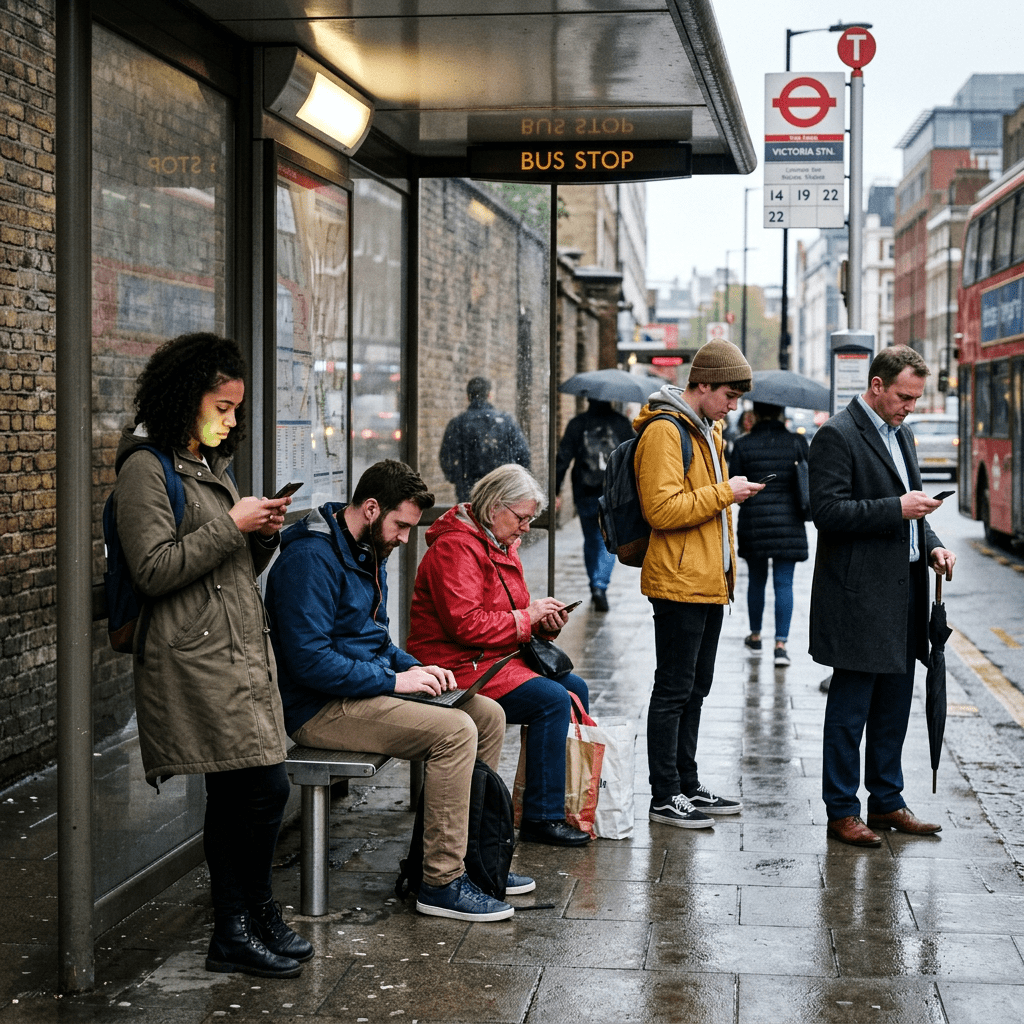
Modern society has become remarkably efficient at filling every empty space.
A few moments waiting for an elevator become an opportunity to check notifications. A train journey becomes time for answering emails. Silence during conversations is quickly interrupted by smartphones. Even before falling asleep, many people scroll endlessly through social media rather than allowing the mind to become still.
Very little is left unoccupied.
Technology has transformed countless moments that were once naturally empty into opportunities for continuous consumption, communication, or productivity.
At first glance, this appears to be progress.
Waiting becomes useful.
Travel becomes productive.
Idle moments become entertaining.
Life seems more efficient than ever before.
Yet something quietly disappears in the process.
The empty spaces that once allowed human beings to reflect, imagine, recover, and simply exist are becoming increasingly rare.
Modern life is no longer defined only by activity.
It is increasingly defined by the absence of inactivity.
Empty Spaces Were Never Empty
Throughout history, human life contained countless intervals that appeared unproductive.
Walking long distances.
Waiting for letters.
Watching the rain.
Sitting quietly after a meal.
Travelling without digital entertainment.
Looking through a window.
These moments often seemed ordinary.
Yet psychologically they were remarkably important.
The human mind continued working even when no visible task was being performed.
Ideas matured.
Emotions settled.
Problems found unexpected solutions.
Memories were organized.
Meaning quietly emerged.
The empty space was never truly empty.
It was occupied by thought.
The Fear of Boredom
One reason empty spaces have disappeared is that modern society has become increasingly uncomfortable with boredom.
Digital technology offers immediate alternatives.
If a conversation pauses, there is a phone.
If a queue forms, there is social media.
If work becomes mentally exhausting, there are endless videos, news feeds, or AI conversations waiting to fill attention.
Boredom has become something to eliminate.
Yet psychologists increasingly suggest that boredom serves important functions.
Periods of reduced stimulation encourage imagination, curiosity, and creative thinking.
The absence of external input often allows internal reflection to begin.
Creativity frequently starts where stimulation ends.
Real Example: The Lost Commute
Consider the daily commute.
Only a few decades ago, travelling to work often meant looking through the window, reading a newspaper, or simply sitting quietly.
Many people reflected on conversations from the previous day or mentally prepared for what awaited them.
Today, that same journey rarely contains silence.
Music streams continuously.
Podcasts accompany every minute.
Messages demand replies.
Social media competes for attention.
Artificial intelligence answers questions before they are fully formed.
The commute remains.
The psychological space it once provided quietly disappears.
Thinking Requires Space
Thought does not develop only through information.
It develops through distance from information.
Nicholas Carr (2010) argues that digital technologies increasingly encourage rapid shifts of attention rather than sustained reflection.
Ideas require time to mature.
Connections between seemingly unrelated experiences often emerge only after periods of quiet observation.
Artificial intelligence can generate immediate answers.
Wisdom often requires unanswered questions.
Without empty spaces, thinking risks becoming continuous reaction rather than genuine reflection.
Creativity Lives in the Gaps
Many of humanity’s greatest creative achievements emerged during moments that appeared unproductive.
Scientists describe discovering solutions while walking.
Writers speak of ideas arriving during quiet evenings.
Artists often value solitude more than stimulation.
Psychological research increasingly suggests that the brain’s default mode network becomes particularly active during moments of rest, mind-wandering, and reflection.
These periods allow the brain to integrate experiences rather than merely process new information.
Creativity depends not only on input.
It depends upon intervals between inputs.
Without gaps, there is little room for imagination.
Relationships Need Empty Time
Relationships also require spaces that cannot be planned.
Some of the most meaningful conversations begin after silence.
Children often ask profound questions during unhurried moments.
Friendships deepen not through scheduled efficiency but through time without clear objectives.
Modern life increasingly organizes relationships around calendars.
Lunch lasts exactly one hour.
Meetings end on schedule.
Video calls begin and conclude according to predefined agendas.
Efficiency improves coordination.
It cannot replace the unpredictable moments through which intimacy develops.
Martin Buber (1937) argued that genuine human encounter requires openness rather than control.
Empty spaces create that openness.
Productivity Has Expanded Into Every Moment
Modern culture increasingly celebrates optimization.
Walking becomes exercise.
Reading becomes self-improvement.
Hobbies become personal branding.
Weekends become opportunities for additional productivity.
Even relaxation is often expected to produce measurable benefits.
Byung-Chul Han (2015) argues that contemporary society has become a performance society where individuals constantly optimize themselves.
The consequence is subtle.
People no longer rest simply to rest.
Every moment must justify its existence.
Even leisure becomes work.
Empty spaces become difficult to defend because they appear economically unproductive.
Artificial Intelligence and the End of Waiting
Artificial intelligence accelerates another important transformation.
Waiting itself begins to disappear.
Questions receive immediate answers.
Documents are summarized instantly.
Images are generated within seconds.
Programming assistance appears immediately.
Translation occurs almost effortlessly.
These developments offer extraordinary benefits.
Yet waiting has historically played an important psychological role.
Waiting encourages patience.
It creates anticipation.
It allows expectations to evolve.
It provides time for reconsideration.
A world without waiting may become a world with fewer opportunities for reflection.
A Data Justice Perspective
A data justice perspective offers another way to understand disappearing empty spaces.
Linnet Taylor (2017) argues that digital systems should be evaluated according to fairness, representation, and governance.
Many contemporary platforms are designed to minimize inactivity.
Autoplay begins automatically.
Infinite scrolling removes natural stopping points.
Notifications interrupt silence.
Recommendation algorithms continuously suggest the next activity.
These design choices reflect economic incentives rather than human psychological needs.
The result is a society where inactivity increasingly appears as system failure rather than an essential part of healthy human life.
Rediscovering the Empty Space
Recovering empty spaces does not require rejecting technology.
It requires protecting moments that technology cannot improve simply because they are already fulfilling their purpose.
Walking without headphones.
Reading without switching applications.
Allowing silence during conversations.
Watching the sunset without photographing it.
Waiting without reaching for a screen.
These actions appear insignificant.
Collectively, they restore a rhythm through which thought, creativity, and emotional balance become possible again.
Sometimes the most meaningful thing a person can do is nothing at all.
Conclusion
Modern society has become extraordinarily successful at eliminating emptiness.
Digital technologies ensure that almost every moment can be filled with information, entertainment, communication, or productivity.
Yet the disappearance of empty spaces carries hidden consequences.
Reflection becomes more difficult.
Creativity becomes fragmented.
Relationships lose unplanned moments.
Wisdom struggles to emerge within lives organized around continuous stimulation.
The challenge facing the digital age is not creating more activity.
It is preserving the spaces where activity stops.
Because human beings do not become wiser by filling every moment.
They become wiser by allowing certain moments to remain beautifully, intentionally, and productively empty.
References
Buber, M. (1937). I and Thou. T&T Clark.
Carr, N. (2010). The Shallows: What the Internet Is Doing to Our Brains. W. W. Norton & Company.
Han, B.-C. (2015). The Burnout Society. Stanford University Press.
Kahneman, D. (2011). Thinking, Fast and Slow. Farrar, Straus and Giroux.
Taylor, L. (2017). “What Is Data Justice? The Case for Connecting Digital Rights and Freedoms Globally.” Big Data & Society, 4(2).


Leave a Reply