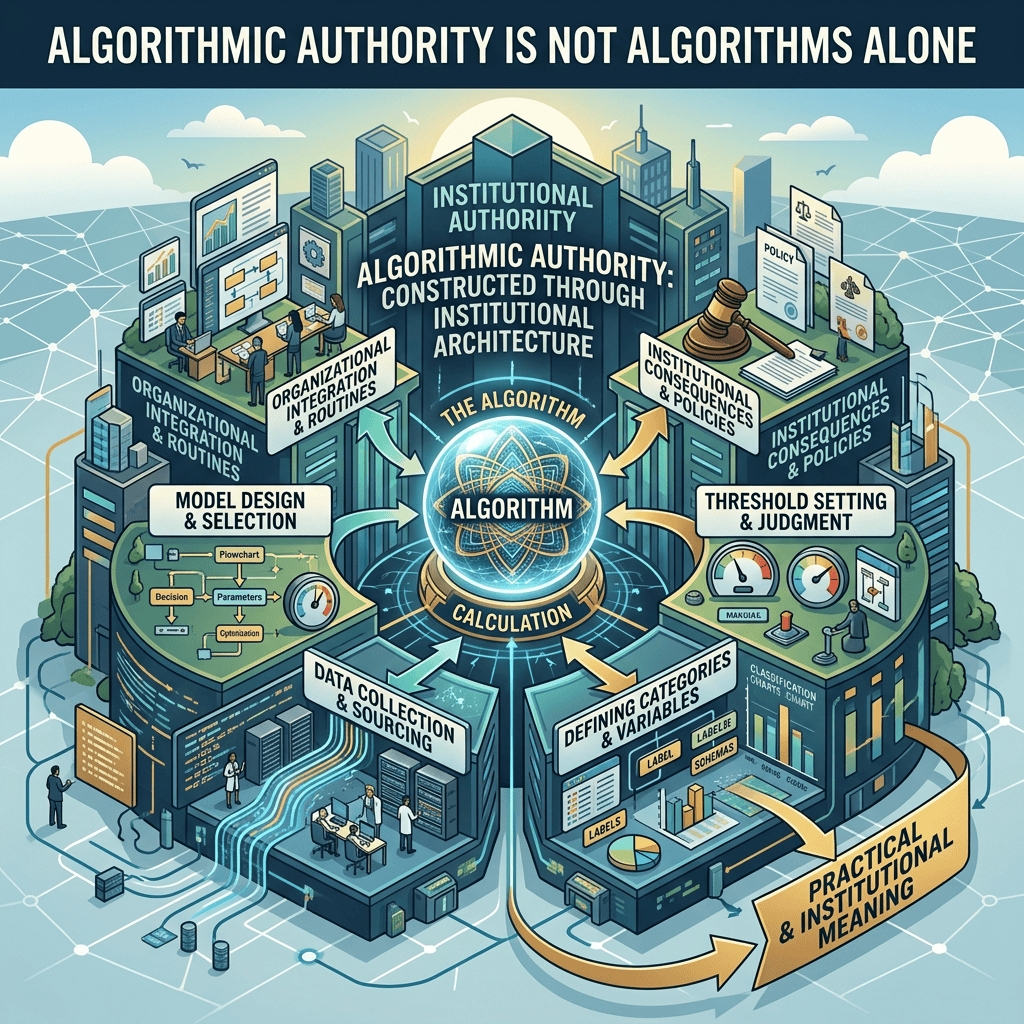
Algorithmic authority does not emerge from algorithms alone. A recommendation, score, ranking, or automated decision may appear to be produced by a technical system, but the authority attached to that output is constructed through a much wider institutional architecture. Data must be collected, categories must be defined, models must be designed, thresholds must be selected, systems must be integrated into organizational routines, and institutions must determine what consequences should follow from the output. The algorithm is therefore only one component within a broader structure that gives computational results practical and institutional meaning.
This distinction is important because public discussion often treats algorithms as if they exercise power independently. In reality, algorithms become authoritative when organizations begin relying on them to organize information, distribute attention, define risk, prioritize action, and justify decisions. What matters is not simply what an algorithm calculates, but how that calculation becomes consequential within an institutional environment.
Authority Begins Before the Output
The visible output of an algorithm is usually the final stage of a much longer process. Before a risk score appears on a screen, someone has already decided what counts as risk. Before a recommendation is generated, someone has determined which variables should matter. Before a ranking becomes visible, someone has chosen the criteria used to establish relevance. These decisions form the architecture within which algorithmic outputs become possible.
Some of these choices are technical, while others are administrative, legal, economic, or political. A platform may optimize for engagement, a public agency may optimize for accuracy, a financial institution may optimize for risk reduction, and a logistics system may optimize for speed. Each objective produces a different form of algorithmic behavior because the system is shaped by the priorities assigned to it.
The algorithm does not select its own purpose. Purpose is defined by institutions. This means that authority begins before computation, at the moment when an organization decides what problem the system should solve and what kind of outcome should count as success.
Data as the Foundation of Authority
Algorithmic systems depend on data because data defines the evidence from which the system operates. A model trained on historical transactions learns from previous behavior, a predictive system built on administrative records inherits the categories contained in those records, and a recommendation engine learns from earlier patterns of interaction.
This makes data one of the foundations of algorithmic authority. Yet data is never a complete representation of reality. It reflects what institutions have chosen to collect, how categories were defined, who appeared in the system, and which experiences remained outside it. Historical datasets may contain incomplete records, outdated classifications, institutional biases, or inequalities produced by earlier social conditions.
When these datasets become the basis for automated systems, the past can acquire new authority over the present. A model may appear to generate a new decision, while part of that decision is actually the continuation of older institutional patterns encoded in data.
Algorithmic authority is therefore partly historical authority. It carries previous choices forward, often without making their origins visible.
Classification as Governance
Every algorithmic system depends on classification. A person becomes part of a category, a transaction becomes normal or suspicious, content becomes relevant or irrelevant, and a case becomes urgent or routine. Classification is necessary because computational systems cannot process social reality without structure.
Yet classification is never merely descriptive. Once a person or event is placed into a category, that category can influence how institutions respond. A high-risk classification may trigger additional scrutiny, a low-priority classification may delay attention, and a recommendation category may determine which options become visible.
Geoffrey Bowker and Susan Leigh Star have shown how classification systems shape social and organizational life by making some distinctions administratively meaningful while rendering others less visible. In algorithmic environments, this process becomes more powerful because classification can occur continuously and at scale.
Millions of people can be categorized without direct interaction. Categories can change dynamically as new data arrives. The system does not need to issue an explicit command because classification itself can determine what happens next.
In this sense, algorithmic authority operates partly through the power to define categories.
Prediction and the Future
Algorithms become especially influential when they move beyond description and begin to predict. A system may estimate which transaction is likely to be fraudulent, which applicant is likely to default, which customer is likely to leave, or which case requires additional attention.
Prediction allows institutions to act before events occur. This can produce real value because risks can be identified earlier and resources can be directed more efficiently. However, prediction also changes the structure of authority because individuals may begin to experience consequences based not on what they have done, but on what a system believes they may do.
A prediction is only a probability, but institutions can convert that probability into action. A score becomes a reason for scrutiny, a forecast becomes a justification for intervention, and a category becomes a basis for differential treatment.
This creates the possibility of feedback loops. If a person classified as high risk receives more scrutiny, more evidence may be collected about them. If another person receives less scrutiny, fewer problems may be detected. The resulting data may then appear to confirm the original classification.
The system begins to shape the reality it later measures.
Algorithmic authority therefore does not simply observe the future. It can influence the conditions through which the future develops.
Interfaces and the Presentation of Authority
Algorithms rarely interact with institutions directly. Their outputs are translated through interfaces such as dashboards, warnings, lists, scores, rankings, and recommendations. These interfaces determine how computational results enter human decision-making.
Design therefore matters.
A score presented prominently may receive more attention than contextual information placed elsewhere. A warning displayed in red may create urgency. A ranked list may imply that the first option is not merely first but preferable. The visual presentation of output can influence how seriously people treat the recommendation.
The interface becomes a bridge between computation and judgment.
This is important because algorithmic authority is not produced only by mathematical accuracy. It is also produced by the way results are communicated, positioned, and integrated into organizational routines.
The same model can have very different effects depending on how its output is presented.
Authority therefore depends not only on calculation, but also on interpretation.
Organizational Routine and Institutional Dependence
An algorithm may begin as a tool whose recommendations are optional. Over time, however, repeated use can transform its institutional status. Employees learn to consult it, managers begin asking for its outputs, and organizational procedures are redesigned around its classifications.
What was once advice can gradually become the default basis for action.
The employee who agrees with the system may need little explanation. The employee who disagrees may be required to justify the deviation. This creates an asymmetry that strengthens the practical authority of the system.
Authority can therefore emerge through routine rather than formal delegation.
The organization becomes dependent on the system because processes, expectations, and accountability structures are gradually built around it.
This is how algorithmic governance often develops in practice. It is not always the result of a dramatic transfer of power from humans to machines. More often, authority shifts through incremental integration.
Human Deference and Computational Credibility
Algorithmic authority also depends on human belief. People must consider the system credible enough to influence their judgment. That credibility may come from statistical performance, technical sophistication, institutional endorsement, or the perception that the system has access to more information than any individual could process.
Such deference is not necessarily irrational. In many situations, digital systems genuinely perform better than humans. Problems arise when deference becomes automatic.
A decision-maker may assume that the model has considered factors it has never actually seen. A manager may accept a score because questioning the system appears technically difficult. An employee may prefer the safety of following the recommendation rather than exercising discretion.
Complexity can therefore strengthen authority.
A system that is difficult to understand may also become difficult to challenge.
This creates a paradox in which opacity can weaken transparency while simultaneously increasing institutional deference.
The less users understand how a result was produced, the more they may rely on the reputation of the system rather than on independent evaluation.
Authority at Scale
Algorithmic authority becomes especially significant when systems operate at large scale. A human decision-maker has limited reach, while a digital system can apply the same logic to millions of cases.
This scale creates consistency, but it also increases the consequences of design choices.
A single classification rule can affect an entire population. A recommendation system can shape what millions of users see. A ranking mechanism can influence attention across a society.
At this scale, technical choices become structural.
A minor assumption in a model can produce large effects when repeated continuously. A system may appear reasonable in each individual case while still generating significant patterns of exclusion or inequality across a population.
Algorithmic authority must therefore be evaluated not only at the level of individual decisions but also through cumulative effects.
Scale transforms technical architecture into social architecture.
Law and Algorithmic Systems
Algorithmic authority does not operate outside law. It is shaped by regulations, administrative mandates, institutional responsibilities, and legal constraints. Yet the relationship between law and algorithms is often complicated because law usually operates through general principles, while computational systems require explicit operational rules.
A legal requirement may demand fairness, but a model still needs a measurable definition of fairness. A regulation may prohibit discrimination, but designers must still determine which variables are permissible. A policy may require transparency, but institutions must decide what kind of explanation is sufficient.
This process translates normative principles into technical structures.
Important judgments can therefore enter during implementation.
The architecture of algorithmic authority includes not only engineers and data scientists, but also lawyers, administrators, policy-makers, managers, and institutional leaders.
System design becomes part of governance because the translation from legal principle to computational rule determines how authority is exercised in practice.
Distributed Responsibility
One of the most difficult problems created by algorithmic systems is the fragmentation of responsibility. A single automated process may involve many actors. One organization collects the data, another builds the model, a vendor supplies the infrastructure, a public institution deploys the system, employees interpret the output, and managers determine the consequences.
When something goes wrong, responsibility can become difficult to locate.
The employee may say the system recommended the outcome. The institution may say the vendor designed the system. The vendor may say the model performed according to specification. The model itself may have been trained on data produced by historical institutional practices.
Responsibility disperses while authority remains effective.
This creates the risk of accountability gaps.
Governance therefore requires more than identifying who pressed the final button. Institutions need to understand the entire chain through which decisions are produced.
If algorithmic authority is architectural, accountability must be architectural as well.
The Illusion of Autonomous Decision
Public discussion often uses language suggesting that algorithms decide independently. We say that the system rejected an application, the model classified a person, or the algorithm recommended an action.
This language is convenient, but it can obscure institutional responsibility.
Algorithms operate inside environments designed by people. Their objectives are assigned, their data is selected, their outputs are interpreted, and their consequences are determined by institutions.
Even systems capable of adaptive learning remain bounded by architectures created by human choices.
Autonomy at the level of execution is therefore not the same as autonomy at the level of purpose.
A system may act automatically, but the institution still determines why that action matters.
This distinction is essential because the appearance of machine autonomy can make human governance less visible.
The more independent a system appears, the easier it becomes to forget that its authority depends on institutional decisions.
The Politics of Optimization
Every algorithmic system optimizes something. Search systems optimize relevance, platforms may optimize engagement, logistics systems optimize efficiency, and risk models optimize prediction.
Optimization requires priorities.
Improving one objective can weaken another. A system optimized entirely for speed may reduce deliberation. A system optimized for security may reduce convenience. A model optimized for accuracy may become less interpretable. A platform optimized for engagement may privilege content that generates stronger reactions.
These trade-offs reveal the political dimension of optimization.
The algorithm does not merely calculate. It embodies a hierarchy of priorities.
The critical question is therefore not only whether the system performs well, but what it has been designed to treat as success.
Technical performance can be excellent while institutional purpose remains questionable.
A highly optimized system may still optimize the wrong thing.
Human Judgment Within Algorithmic Systems
Human judgment remains central because algorithmic outputs do not determine how much weight they should receive. A score does not decide whether it should override other evidence. A recommendation does not establish whether it should be followed. A prediction does not determine whether intervention is justified.
These are institutional judgments.
The danger is that the precision of algorithmic outputs can make people less willing to exercise them.
A decision-maker may defer to the score because it appears objective. An organization may prefer the consistency of the model because it reduces visible discretion. Over time, the space for human interpretation may narrow.
This is why stronger algorithmic systems require stronger human capability.
People using them need to understand their limits, recognize exceptional circumstances, question inappropriate outputs, and know when contextual information should outweigh computational recommendations.
The goal is not to preserve human discretion for its own sake.
It is to preserve the capacity to recognize situations in which the system’s logic is insufficient.
Making Algorithmic Authority Visible
One of the central challenges of digital governance is visibility. Traditional authority is comparatively easy to identify because people know when they are dealing with a formal decision.
Algorithmic authority is often more difficult to see.
A ranking may shape opportunity without appearing as a decision. A recommendation may influence behavior without appearing as regulation. A score may affect treatment without being publicly visible.
The architecture becomes powerful partly because it disappears into routine.
Making algorithmic authority visible therefore requires more than publishing technical documentation. People need to understand when automated systems are being used, what role they play, and what consequences their outputs produce.
Institutions need to explain how classifications affect decisions. Users need meaningful ways to challenge errors. Decision-makers need to understand how design choices influence behavior.
Transparency should not mean exposing every line of code.
It should mean making the structure of authority understandable.
Governing the Architecture
The future of algorithmic governance will depend less on whether algorithms become more capable and more on whether institutions become capable of governing the architectures around them.
This requires technical expertise, but technical expertise alone is not enough. Institutions also need legal understanding, ethical judgment, administrative capacity, and mechanisms for accountability.
They need to ask not only whether a system works, but what kind of institutional behavior it creates.
They need to evaluate not only accuracy, but also consequences.
They need to examine not only outputs, but also the structures that produce them.
Algorithmic authority is not located in one place. It emerges from relationships between data, models, interfaces, rules, organizations, and people.
Understanding these relationships is essential because authority that appears purely technical can escape broader institutional scrutiny.
The challenge is therefore not to remove authority from algorithms. Algorithms do not possess authority independently.
The challenge is to make visible the architecture through which institutions give their outputs authority.
Beyond the Algorithm
The most important mistake in thinking about algorithmic power is to focus too narrowly on the algorithm itself.
The algorithm is only one component within a larger institutional structure. Data defines what can be known, models define what can be inferred, interfaces define what becomes visible, organizations determine how outputs are used, law establishes boundaries, and institutions determine consequences.
Human beings remain present throughout this architecture even when they are no longer visible at the moment of decision.
This is why debates about algorithmic governance should move beyond the question of whether machines are making decisions. The deeper question is how institutions are reorganizing decision-making around machines.
Once this shift is understood, algorithmic authority becomes easier to see. It is not an autonomous force emerging from code, but a form of institutional power assembled through technical, administrative, legal, and organizational structures.
The quality of algorithmic authority will therefore depend on whether society is capable of understanding, questioning, and governing the architecture that makes it possible.
References
Bowker, G. C., & Star, S. L. (1999). Sorting Things Out: Classification and Its Consequences. MIT Press.
Gillespie, T. (2014). The relevance of algorithms. In T. Gillespie, P. J. Boczkowski, & K. A. Foot (Eds.), Media Technologies: Essays on Communication, Materiality, and Society. MIT Press.
Lessig, L. (2006). Code: And Other Laws of Cyberspace, Version 2.0. Basic Books.
Pasquale, F. (2015). The Black Box Society: The Secret Algorithms That Control Money and Information. Harvard University Press.
Yeung, K. (2017). ‘Hypernudge’: Big Data as a mode of regulation by design. Information, Communication & Society, 20(1), 118–136.
Yeung, K., & Lodge, M. (Eds.). (2019). Algorithmic Regulation. Oxford University Press.

