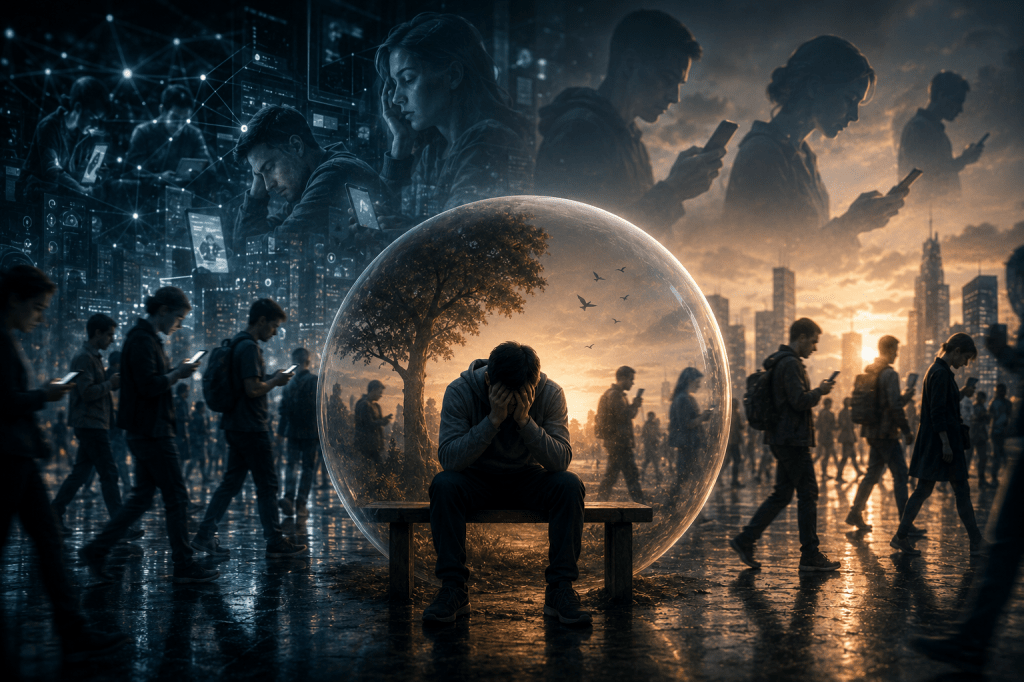
Modern life is often described as more connected, efficient, and technologically advanced than ever before. Digital systems provide instant communication, information is continuously accessible, and institutions increasingly organize everyday activities through automated infrastructures designed to optimize speed and convenience. From work and education to entertainment and social interaction, contemporary society operates through systems promising greater control over time and uncertainty.
Yet beneath this appearance of efficiency lies a quieter emotional reality.
Many people move through modern life carrying persistent anxiety that rarely appears dramatic enough to be recognized openly, but remains present almost constantly in the background of everyday experience. It is not always panic or crisis. More often, it appears as continuous tension, emotional fatigue, restlessness, or the inability to feel fully at ease even during moments of rest.
This is the quiet anxiety of modern life.
It emerges not only from individual psychology, but from the structure of contemporary society itself. Economic uncertainty, digital visibility, accelerated culture, institutional pressure, and continuous evaluation create environments where individuals feel increasingly required to adapt, perform, and remain responsive without interruption.
The result is a society where anxiety becomes normalized.
Living Under Continuous Pressure
One of the defining characteristics of modern society is the expansion of continuous pressure.
Work increasingly extends beyond traditional boundaries through emails, messaging platforms, remote systems, and digital connectivity. Social media creates constant exposure to comparison and visibility, while economic uncertainty intensifies concerns regarding stability, achievement, and future security.
Hartmut Rosa (2013) describes contemporary society as shaped by social acceleration, where technological speed transforms institutions, communication, and human expectations simultaneously.
People are expected to respond faster, adapt continuously, and remain productive within systems that rarely pause. Delays increasingly appear inefficient, while slowness may be interpreted as weakness or lack of ambition.
This creates a subtle but persistent emotional condition.
Even when individuals are not actively facing crisis, they often remain psychologically prepared for pressure.
The nervous system rarely experiences complete rest because modern life itself becomes organized around continuous responsiveness.
The Anxiety of Constant Connectivity
Digital connectivity has intensified this condition significantly.
Smartphones, social media platforms, and instant communication systems ensure that individuals remain reachable almost continuously. Messages arrive at all hours, notifications interrupt attention repeatedly, and information flows without meaningful limits.
Sherry Turkle (2011) argues that digital technologies reshape how individuals experience connection, presence, and solitude. Continuous connectivity creates environments where disconnection itself becomes psychologically difficult.
The result is not only informational overload.
It is emotional overstimulation.
People become accustomed to monitoring messages, updates, and social visibility constantly. Silence itself can begin to feel uncomfortable because modern systems normalize permanent engagement.
This creates a paradox.
Technologies designed to increase connection may also weaken emotional calm.
Economic Uncertainty and Invisible Stress
Economic instability also contributes significantly to the quiet anxiety of modern life.
Inflation, rising living costs, unstable labor markets, debt pressure, and fears regarding future security create persistent background stress even among individuals who continue functioning normally in daily routines.
Unlike visible economic crises of the past, modern economic anxiety is often chronic rather than sudden.
People may remain employed while still feeling uncertain about long term stability. Young adults face housing insecurity despite professional qualifications, middle class workers worry about financial vulnerability despite constant productivity, and many individuals feel pressured to maintain lifestyles increasingly difficult to sustain economically.
Zygmunt Bauman (2007) describes modern society as increasingly characterized by insecurity and fluidity, where stable social structures become weaker and individuals must navigate uncertainty continuously.
This instability creates psychological tension because human beings seek predictability and security in order to feel emotionally grounded.
Modern life often provides neither fully.
Social Media and the Performance of Happiness
Social media intensifies emotional anxiety by transforming visibility into social expectation.
Digital platforms encourage individuals to present curated versions of themselves through images, achievements, opinions, and lifestyle representation. Everyday life becomes partially performative because visibility itself carries social value.
Shoshana Zuboff (2019) argues that digital economies increasingly rely on behavioral engagement and continuous interaction to sustain platform systems.
Within these environments, individuals compare themselves constantly against carefully constructed images of success, productivity, attractiveness, and happiness.
The consequences are psychological.
People may feel inadequate even while functioning successfully according to ordinary standards of life. Comparison becomes continuous because social media collapses distance between personal experience and public visibility.
The anxiety produced is often quiet because it does not always emerge as dramatic emotional breakdown.
Instead, it appears as persistent dissatisfaction and subtle emotional exhaustion.
Real Example: Burnout in Professional Culture
One visible manifestation of modern anxiety is the global rise of burnout culture.
In many professional environments, workers experience emotional exhaustion despite remaining highly functional externally. Productivity expectations continue expanding through digital systems that blur boundaries between work and personal life.
Remote work technologies, while offering flexibility, have also intensified the expectation of constant availability in many industries.
Employees may respond to messages late at night, remain mentally connected to work during weekends, and feel pressure to maintain visible productivity continuously.
The World Health Organization formally recognized burnout as an occupational phenomenon characterized by emotional exhaustion, reduced professional efficacy, and mental distance from work.
Importantly, burnout often develops gradually.
It reflects accumulated emotional strain rather than isolated crisis.
This illustrates how modern anxiety frequently operates quietly beneath ordinary daily functioning.
The Fear of Falling Behind
Another defining feature of contemporary anxiety is the fear of falling behind.
Modern society increasingly measures success through visible achievement, productivity, financial progress, and social visibility. Individuals compare careers, relationships, lifestyles, and personal milestones against accelerated timelines shaped partly by digital culture.
Byung-Chul Han (2015) argues that contemporary society functions increasingly as a “performance society” where individuals internalize pressure to optimize themselves continuously.
This pressure creates emotional instability because there is rarely a clear endpoint.
No matter how productive or successful individuals become, there often remains another standard to pursue, another expectation to satisfy, or another comparison to confront.
The anxiety is quiet because it becomes normalized socially.
People continue functioning while carrying persistent feelings that they should always be doing more.
The Loss of Emotional Space
Modern systems also reduce opportunities for emotional recovery.
Historically, human life contained clearer boundaries between labor and rest, public and private life, communication and solitude. Contemporary digital society weakens many of these distinctions.
Jonathan Crary (2013) argues that modern capitalism increasingly eliminates interruption and inactivity in favor of continuous engagement and availability.
This affects emotional life directly.
Moments once associated with reflection or psychological rest become filled with notifications, entertainment streams, digital communication, and productivity expectations. Silence becomes rare.
The consequence is emotional overcrowding.
People struggle not only because they work too much, but because modern life leaves insufficient space for mental stillness and emotional processing.
Anxiety Without Visible Crisis
One reason modern anxiety can feel confusing is because it often exists without obvious catastrophe.
Individuals may have employment, social relationships, and relatively stable lives while still experiencing ongoing emotional tension. This creates difficulty because anxiety traditionally becomes associated with visible crisis or dysfunction.
Contemporary anxiety is often quieter.
It appears through insomnia, overthinking, emotional numbness, irritability, difficulty resting, or persistent feelings of unease difficult to explain clearly.
Alain Ehrenberg (2010) argues that modern societies increasingly produce psychological exhaustion because individuals face pressure to construct meaning, achievement, and identity continuously within environments emphasizing personal responsibility and self optimization.
People become emotionally tired not only from suffering, but also from constant adaptation.
Human Beings and the Need for Stability
Human beings require more than productivity and connectivity.
People need emotional stability, meaningful relationships, rest, predictability, and moments free from evaluation and performance pressure. Anxiety intensifies when societies prioritize acceleration and optimization while neglecting these psychological conditions.
Hannah Arendt (1958) emphasized the importance of reflective life and meaningful human activity beyond mere labor and functional productivity.
Modern systems often struggle to preserve these dimensions because efficiency and growth remain dominant institutional priorities.
Yet emotional well being depends partly on experiences that cannot easily be optimized.
Stillness, patience, reflection, trust, and human presence require forms of slowness increasingly difficult to sustain within accelerated societies.
A Data Justice Perspective
A data justice perspective also helps illuminate modern anxiety.
Linnet Taylor (2017) argues that digital systems should be evaluated according to fairness, representation, and treatment rather than technical efficiency alone.
Continuous monitoring, behavioral evaluation, and algorithmic visibility affect emotional life profoundly. Individuals increasingly live within systems where behavior becomes measurable, comparable, and permanently observable.
The psychological burden of visibility is therefore not merely personal.
It reflects broader structural conditions within digitally mediated societies.
Toward a More Emotionally Sustainable Society
Addressing the quiet anxiety of modern life requires more than individual coping strategies alone.
At the institutional level, organizations must reconsider cultures of permanent availability and continuous productivity pressure.
At the technological level, digital systems should support human well being rather than maximizing engagement and behavioral extraction endlessly.
At the societal level, public discussions about success and progress should include emotional sustainability alongside economic performance and efficiency.
Most importantly, societies must recognize that emotional exhaustion is not simply individual weakness.
It often reflects environments that demand too much psychological adaptation without providing sufficient stability or rest.
Conclusion
The quiet anxiety of modern life emerges from the structure of contemporary society itself.
Continuous connectivity, economic uncertainty, accelerated culture, social comparison, and systems of permanent evaluation create environments where individuals feel pressured to remain adaptive, visible, and productive almost constantly.
This anxiety is often subtle rather than dramatic.
It exists beneath ordinary routines, professional achievement, and daily functionality. Many people continue moving through life successfully while carrying persistent emotional tension difficult to name fully.
The challenge is not simply personal.
It is societal.
Modern life has become highly efficient at organizing activity, communication, and productivity, yet increasingly ineffective at protecting emotional calm and psychological stability.
A more humane society will require more than technological advancement alone.
It will require creating conditions where people can exist without feeling continuously overwhelmed by the pressure of modern life itself.
References
Arendt, H. (1958). The Human Condition. University of Chicago Press.
Bauman, Z. (2007). Liquid Times: Living in an Age of Uncertainty. Polity Press.
Crary, J. (2013). 24/7: Late Capitalism and the Ends of Sleep. Verso.
Ehrenberg, A. (2010). The Weariness of the Self: Diagnosing the History of Depression in the Contemporary Age. McGill-Queen’s University Press.
Han, B. C. (2015). The Burnout Society. Stanford University Press.
Rosa, H. (2013). Social Acceleration: A New Theory of Modernity. Columbia University Press.
Taylor, L. (2017). “What Is Data Justice? The Case for Connecting Digital Rights and Freedoms Globally.” Big Data & Society, 4(2).
Turkle, S. (2011). Alone Together: Why We Expect More from Technology and Less from Each Other. Basic Books.
Zuboff, S. (2019). The Age of Surveillance Capitalism. PublicAffairs.


Leave a Reply