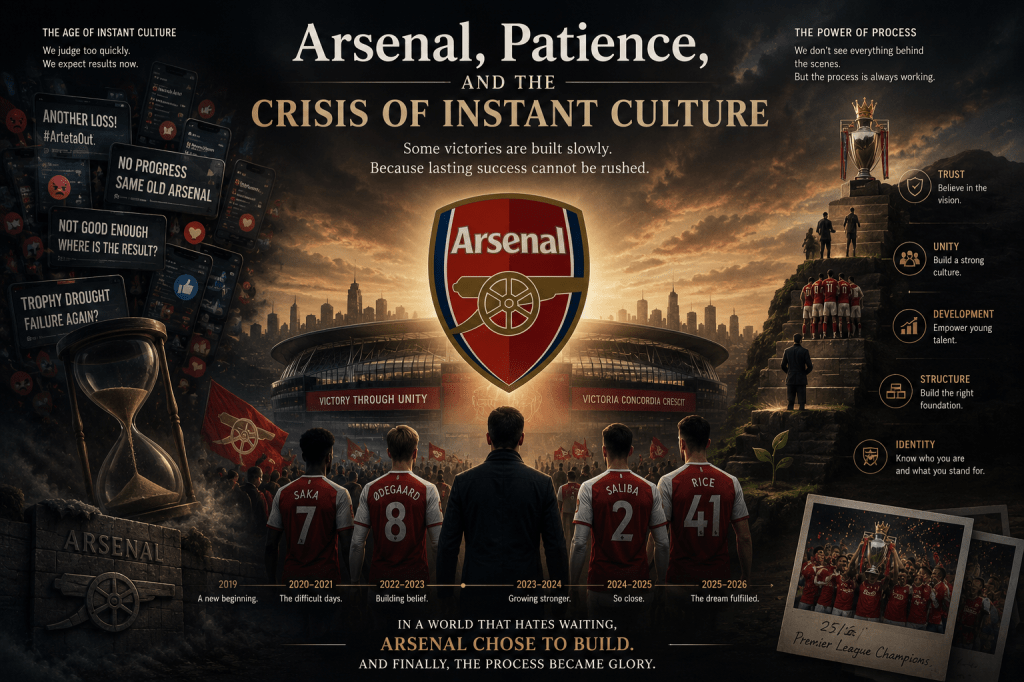
Modern society struggles with waiting.
Across digital culture, politics, business, and even personal life, speed has become one of the defining values of the contemporary era. Social media accelerates public judgment, markets demand immediate growth, and institutions face constant pressure to deliver visible results quickly. In many environments, patience is increasingly interpreted not as discipline, but as weakness. Progress is expected to be immediate, and delays are often treated as evidence of failure.
This culture of acceleration shapes how people evaluate almost everything.
Projects are judged before they mature, leaders are criticized before systems stabilize, and institutions are expected to prove success continuously in real time. The modern world rewards visibility, reaction, and rapid outcomes far more easily than long term development.
Within this environment, the story of Arsenal under Mikel Arteta offers something increasingly rare.
It offers a story about patience.
Not passive patience, but disciplined patience grounded in long term vision, institutional rebuilding, and trust in process despite public pressure and repeated disappointment.
The eventual Premier League success of Arsenal in the 2025/26 season can therefore be understood as more than a football achievement.
It reflects a broader lesson about process in an age increasingly dominated by instant culture.
The Culture of Immediate Results
Modern culture is deeply shaped by immediacy.
Digital platforms provide instant communication, entertainment is available continuously, and algorithmic systems reward rapid visibility and constant engagement. Public attention moves quickly, and social judgment often forms before complexity can be properly understood.
Hartmut Rosa (2013) describes contemporary society as characterized by social acceleration, where technological speed transforms not only institutions, but also human expectations regarding time and progress.
This acceleration affects football culture as well.
Managers are expected to deliver immediate success, players are judged weekly through social media reaction, and clubs face relentless pressure from news cycles and online discourse. Patience becomes increasingly difficult because modern sports culture mirrors broader societal demands for constant proof of performance.
Within such an environment, rebuilding a football institution slowly appears risky.
Failure becomes highly visible, while long term vision struggles to survive short term criticism.
Arsenal and the Burden of Process
When Mikel Arteta became Arsenal manager in 2019, the club was experiencing institutional instability.
Arsenal had lost competitive consistency, squad balance appeared fragmented, and confidence within the club environment had weakened significantly after years of transition following the era of Arsène Wenger.
The rebuilding process was difficult and often painful.
There were poor performances, tactical inconsistencies, controversial decisions, and periods where supporters openly questioned whether the project was progressing at all. Social media intensified every setback, and criticism frequently focused on the perceived slowness of development.
In an instant culture, slowness often appears indistinguishable from failure.
Yet Arsenal continued investing in long term structure rather than immediate reaction.
Young players were trusted. Recruitment focused increasingly on profile and system compatibility rather than short term celebrity solutions. Tactical identity became clearer over time, even when results temporarily fluctuated.
The process demanded patience precisely because meaningful institutional rebuilding cannot occur instantly.
Trusting Systems Before Results Arrive
One of the most difficult aspects of long term projects is that visible results often emerge later than public expectation allows.
Modern culture prefers immediate validation because uncertainty is emotionally uncomfortable. People want evidence quickly that systems are working. When results do not appear immediately, pressure intensifies to abandon the process entirely.
This dynamic extends far beyond football.
Governments face pressure for instant policy outcomes, companies prioritize quarterly performance over sustainable development, and individuals increasingly compare their progress against accelerated digital timelines shaped by social media visibility.
Byung-Chul Han (2015) argues that contemporary society increasingly functions as a “performance society” where continuous achievement and visible success become central forms of social legitimacy.
Arsenal under Arteta existed within this same pressure environment.
Every defeat became evidence for critics that the project had failed. Every slow period triggered renewed calls for immediate change. The process itself became difficult to defend because modern culture struggles to tolerate delayed outcomes.
Yet some systems require time precisely because meaningful change involves culture, trust, relationships, identity, and institutional coherence rather than isolated short term results alone.
The Importance of Institutional Identity
Another reason the Arsenal story resonates beyond football is because it concerns institutional identity.
Many organizations facing pressure eventually abandon long term philosophy in pursuit of immediate relief. Short term survival frequently overrides deeper institutional coherence.
Arsenal attempted something more difficult.
The club sought not only to win, but to rebuild a recognizable identity rooted in collective structure, positional football, emotional connection with supporters, and long term development. The process involved constructing an environment where players, leadership, and culture gradually aligned around shared principles.
This dimension matters because institutions without identity often become reactive.
James C. Scott (1998) warns that systems operating under constant pressure frequently prioritize simplification and immediate control over deeper structural understanding.
Arsenal resisted becoming purely reactive.
The club continued building gradually even when external pressure encouraged rapid change.
Real Example: The Transformation of Young Players
One of the clearest examples of patience within the Arsenal project was the development of younger players such as Bukayo Saka, Martin Ødegaard, and William Saliba.
These players were not simply assembled as isolated talents.
They were developed within a long term tactical and cultural structure that required trust, continuity, and gradual growth. Early mistakes were tolerated because development was viewed as part of the process rather than immediate proof of failure.
In modern football culture, young players often face extreme pressure for instant perfection. Social media criticism can become relentless after poor performances, and clubs frequently prioritize immediate success over patient development.
Arsenal’s approach suggested something increasingly uncommon.
Human development cannot always be accelerated without consequence.
The eventual success of these players reflected the value of institutional patience in environments dominated by short term evaluation.
Social Media and the Crisis of Patience
The modern crisis of patience is intensified significantly by digital culture.
Social media platforms reward reaction more than reflection. Emotional responses spread faster than careful analysis, and public discourse often becomes shaped by immediacy rather than long term perspective.
Football supporters experience this environment continuously.
Every match generates real time judgment, tactical debate, and emotional reaction amplified through digital networks. Managers and players exist under permanent evaluation where temporary setbacks may instantly produce narratives of collapse or failure.
Jonathan Crary (2013) argues that contemporary digital capitalism increasingly eliminates spaces for pause and reflection in favor of continuous activity and engagement.
This acceleration affects emotional life itself.
Patience becomes difficult when individuals are immersed constantly within environments demanding immediate interpretation and visible results.
Arsenal’s process unfolded within precisely this cultural environment.
Its eventual success therefore carried symbolic meaning beyond football.
Process Versus Instant Gratification
The Arsenal story also reflects a broader tension between process and instant gratification.
Modern societies increasingly prioritize outcomes detached from the slower realities of development. Success becomes imagined as immediate breakthrough rather than gradual accumulation of trust, structure, and resilience.
Yet many meaningful achievements emerge precisely through delayed progress.
Institutional rebuilding, human development, trust formation, and cultural transformation require time because they involve complexity rather than simple optimization.
Simon Sinek (2019) argues that sustainable organizations operate according to “infinite game” principles where long term continuity matters more than short term victories alone.
Arsenal’s eventual league success reflected this philosophy.
The club pursued structural development patiently rather than constantly restarting the process after every setback.
In a culture obsessed with immediate gratification, this itself became unusual.
The Emotional Logic of Patience
Patience is often misunderstood as passive waiting.
In reality, meaningful patience involves emotional discipline.
It requires tolerating uncertainty without abandoning long term direction prematurely. This is psychologically difficult because uncertainty creates anxiety, and modern systems increasingly encourage immediate resolution of discomfort.
The Arsenal process demanded emotional resilience from players, management, and supporters alike.
Trusting the process meant accepting temporary imperfection without losing belief in broader institutional direction. It required resisting the emotional volatility amplified by modern football culture and digital reaction cycles.
This emotional dimension explains why patience has become increasingly rare.
Patience depends on the ability to value long term meaning over immediate validation.
Modern culture struggles with this balance.
What Modern Society Can Learn
The story of Arsenal’s eventual success offers lessons extending beyond football itself.
It suggests that not every meaningful system can be optimized instantly. Some forms of development require continuity, trust, experimentation, and tolerance for temporary failure.
Modern institutions increasingly struggle with this reality because environments dominated by constant evaluation reward immediate visibility more easily than patient construction.
The Arsenal project therefore became symbolic of something larger.
It represented the possibility that process still matters in an age increasingly hostile toward waiting.
This does not mean patience guarantees success.
Rather, it means sustainable success often depends on forms of development invisible during earlier stages of the process itself.
Conclusion
The story of Arsenal under Mikel Arteta reflects more than a football achievement.
It reflects a broader tension within contemporary society between long term process and instant culture. Modern systems increasingly reward speed, reaction, and immediate results while making patience appear irrational or outdated.
Yet meaningful institutional rebuilding often requires exactly the qualities modern culture struggles to sustain.
Trust. Continuity. Emotional resilience. Long term vision.
Arsenal’s eventual success demonstrated that some systems cannot be rebuilt instantly because human development, institutional identity, and collective trust require time to mature.
In an age obsessed with acceleration, that lesson may matter far beyond football itself.
References
Arendt, H. (1958). The Human Condition. University of Chicago Press.
Crary, J. (2013). 24/7: Late Capitalism and the Ends of Sleep. Verso.
Han, B. C. (2015). The Burnout Society. Stanford University Press.
Rosa, H. (2013). Social Acceleration: A New Theory of Modernity. Columbia University Press.
Scott, J. C. (1998). Seeing Like a State. Yale University Press.
Sinek, S. (2019). The Infinite Game. Portfolio.


Leave a Reply