Reality has never been experienced directly.
Human beings have always understood the world through stories, symbols, images, memories, language, and cultural interpretation. Every society constructs meanings that help people navigate everyday life. In this sense, reality has always involved representation as much as observation.
What distinguishes the present era is not that representations exist.
It is that representations are increasingly produced by machines.
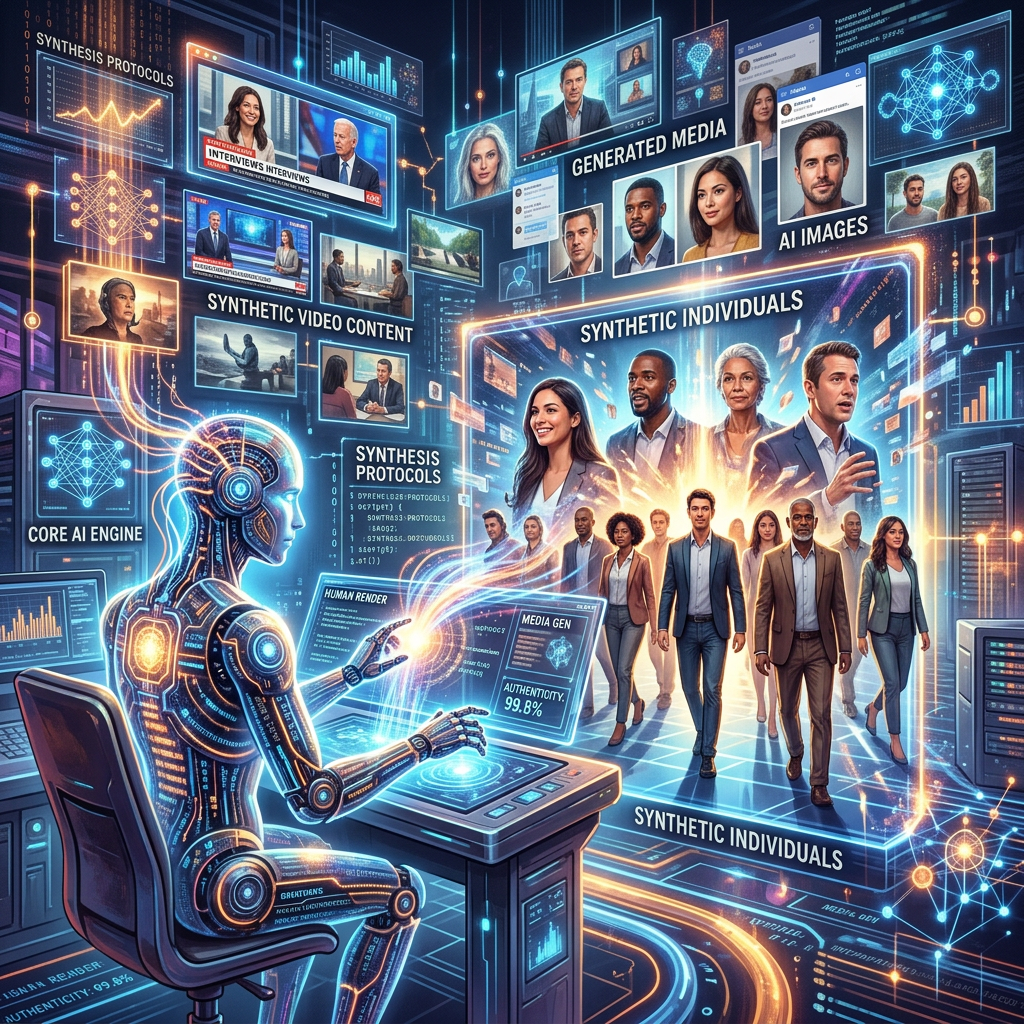
Artificial intelligence can generate photographs of people who never lived, videos of events that never occurred, voices that belong to no speaker, and conversations that no human has actually written. Digital environments are becoming populated by synthetic content that closely resembles reality while existing independently of it.
The distinction between what is real and what is generated is becoming increasingly difficult to recognize.
As a result, society is entering a new condition.
People are no longer simply using artificial intelligence.
They are beginning to live with synthetic reality.
This transformation extends far beyond technology.
It changes how people trust, remember, communicate, and understand the world around them.
From Representation to Generation
For centuries, technologies primarily recorded reality.
Photography captured moments.
Audio devices recorded voices.
Video documented events.
Although these technologies could be manipulated, their primary purpose was representation.
Artificial intelligence introduces a different capability.
Instead of recording reality, it generates reality.
Images no longer require cameras.
Music no longer requires musicians.
Voices no longer require speakers.
Text no longer requires direct authorship.
The shift is profound.
Technology is moving from documenting human experience to creating experiences that may never have existed.
This transformation changes the relationship between reality and evidence.
When Seeing Is No Longer Believing
Visual evidence has traditionally carried exceptional persuasive power.
Photographs and videos were often treated as reliable records because they appeared to capture events directly. Although editing techniques have always existed, producing convincing fabrications required significant expertise and resources.
Today, generative AI dramatically lowers these barriers.
Deepfake technologies can produce highly realistic videos of public figures making statements they never made. AI generated photographs can depict entirely fictional events with remarkable detail. Synthetic voices can imitate real people convincingly enough to create confusion.
The consequence is not merely the spread of false information.
It is the erosion of confidence in evidence itself.
When almost any image can be fabricated, seeing alone no longer guarantees believing.
Synthetic Reality Beyond Misinformation
Public discussions often focus on synthetic media as a misinformation problem.
While misinformation is important, synthetic reality extends much further.
Artificial intelligence increasingly shapes entertainment, education, advertising, journalism, architecture, healthcare, customer service, and everyday communication. Many people interact daily with AI generated content without consciously recognizing it.
Synthetic reality is becoming ordinary.
Students use AI generated learning materials.
Businesses create marketing images through generative systems.
Designers collaborate with AI during creative processes.
Consumers interact with conversational agents that resemble human dialogue.
The issue is not simply distinguishing truth from falsehood.
It is learning how to navigate environments where human and machine generated experiences coexist continuously.
Real Example: AI Influencers and Digital Identity
One of the clearest examples of synthetic reality is the emergence of virtual influencers.
These digital personalities have realistic appearances, maintain social media accounts, collaborate with global brands, and attract millions of followers despite not existing as human beings.
Many audiences understand that these figures are artificial.
Yet they still engage with them emotionally, follow their activities, and respond to their content as though interacting with recognizable personalities.
This development illustrates an important shift.
Authenticity is no longer determined solely by whether something is biologically human.
Instead, audiences increasingly evaluate whether an experience feels meaningful, consistent, or emotionally engaging.
Reality becomes shaped not only by existence but also by perception.
Memory in an Artificial Environment
Synthetic reality also changes how societies remember.
Historically, archives, photographs, official documents, and recorded testimony helped preserve collective memory. Although historical interpretation always involved debate, documentary evidence provided important points of reference.
As AI generated content becomes increasingly widespread, future generations may encounter archives containing both authentic and synthetic materials.
This creates new challenges.
How should societies preserve trustworthy historical records?
How should institutions authenticate digital evidence?
How should public memory adapt when digital fabrication becomes technically simple?
These questions concern not only technology.
They concern cultural continuity.
Human Perception and Cognitive Trust
Human perception evolved in environments where sensory evidence generally corresponded with physical reality.
People naturally trust faces, voices, photographs, and spoken language because these cues historically reflected direct experience.
Synthetic reality challenges these assumptions.
Daniel Kahneman (2011) argues that people rely heavily on cognitive shortcuts when evaluating information. Visual realism often encourages intuitive trust because the brain processes convincing images rapidly without extensive analytical verification.
Artificial intelligence exploits this tendency unintentionally.
Synthetic realism becomes persuasive precisely because it resembles experiences human cognition evolved to trust.
The challenge therefore lies not in human weakness.
It lies in changing technological conditions.
Living Between Two Realities
Increasingly, everyday life unfolds simultaneously across physical and synthetic environments.
People participate in physical meetings while interacting with AI generated summaries. Creative professionals collaborate with machine generated ideas. News consumers encounter both authentic and synthetic visual material. Students combine human instruction with AI assisted learning.
The future is unlikely to involve choosing between real and synthetic worlds.
Instead, people will inhabit both.
The central challenge becomes maintaining appropriate distinctions between them.
Synthetic reality can enrich creativity, education, and communication.
It should not replace critical judgment regarding truth, accountability, and lived experience.
A Data Justice Perspective
A data justice perspective offers an essential framework for understanding synthetic reality.
Linnet Taylor (2017) argues that digital systems should be evaluated according to fairness, representation, and governance.
Generative AI systems are trained using enormous quantities of human created data. Questions therefore arise regarding authorship, consent, intellectual property, transparency, and accountability.
Who should disclose when content is AI generated?
How should synthetic media be governed during elections, legal proceedings, or public emergencies?
Who bears responsibility when synthetic content causes social harm?
Synthetic reality is not merely a technical development.
It is also a governance challenge requiring new institutional responses.
Preserving Human Reality
As synthetic reality expands, human experiences may become increasingly valuable rather than less.
Direct conversation.
Shared presence.
Personal testimony.
Verified expertise.
Lived experience.
These forms of reality cannot simply be generated through algorithms because they emerge from lives actually lived.
Charles Taylor (1991) argues that authenticity depends upon fidelity to lived experience rather than merely successful performance.
This insight becomes increasingly important in environments where convincing performance can be generated artificially.
The value of human experience lies not in perfection.
It lies in its reality.
Conclusion
Living with synthetic reality represents one of the defining challenges of the digital age.
Artificial intelligence is transforming how images, voices, texts, and experiences are created, making synthetic content an ordinary part of everyday life. These developments offer remarkable opportunities for creativity, education, communication, and innovation.
At the same time, they require societies to reconsider long standing assumptions about evidence, authenticity, memory, and trust.
The future will not be divided neatly between reality and artificiality.
It will involve learning how to navigate both responsibly.
Technology can generate increasingly convincing representations of the world.
What it cannot replace is the importance of human judgment in deciding what deserves trust, what deserves doubt, and what ultimately deserves to be called real.
Living with synthetic reality therefore demands more than technological literacy.
It requires renewed commitment to truth, transparency, and the uniquely human capacity to distinguish appearance from understanding.
References
Kahneman, D. (2011). Thinking, Fast and Slow. Farrar, Straus and Giroux.
Taylor, C. (1991). The Ethics of Authenticity. Harvard University Press.
Taylor, L. (2017). “What Is Data Justice? The Case for Connecting Digital Rights and Freedoms Globally.” Big Data & Society, 4(2).
Turkle, S. (2011). Alone Together: Why We Expect More from Technology and Less from Each Other. Basic Books.
Zuboff, S. (2019). The Age of Surveillance Capitalism. PublicAffairs.


Leave a Reply