Hope as an Economic Resource
Economics is often described as the study of scarce resources.
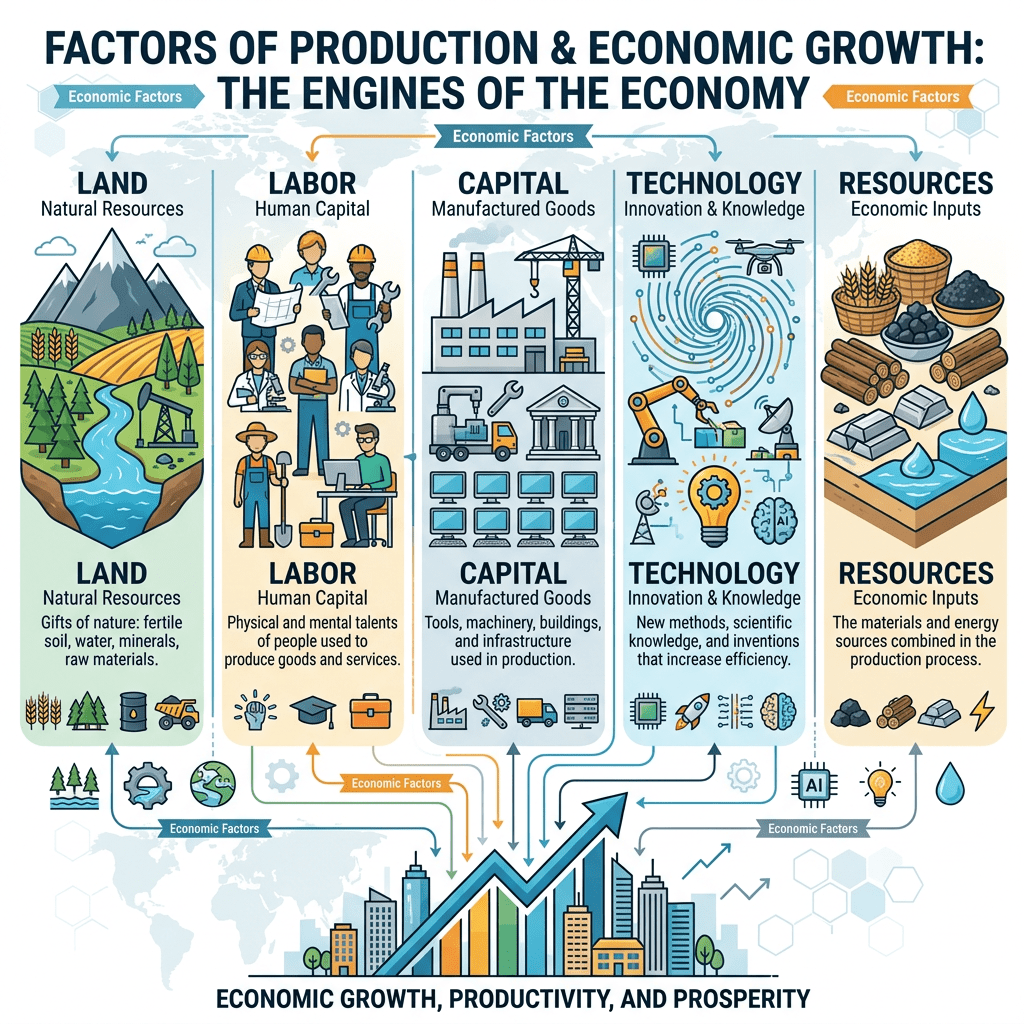
Land, labor, capital, technology, and natural resources occupy central positions within economic theory because they shape how societies produce goods, distribute wealth, and pursue prosperity. Governments monitor inflation, employment, productivity, and investment because these indicators influence economic stability and long term development.
Yet behind every economic decision lies something that cannot be measured as easily.
Hope.
People rarely invest only because they possess capital.
They invest because they believe tomorrow will offer opportunities worth pursuing.
Families do not save merely because income allows them to do so.
They save because they expect the future to reward today’s sacrifice.
Entrepreneurs establish businesses because they imagine possibilities that do not yet exist.
Workers pursue education because they believe their efforts will improve their lives.
Hope is not simply an emotion.
It functions as an economic resource.
Without it, markets may continue operating, but economic life gradually loses the confidence that allows societies to grow.
Expectations Shape Economic Reality
One of the most distinctive characteristics of economic behavior is that it is strongly influenced by expectations.
Consumers decide whether to spend or save based not only on current income but also on how they perceive the future. Businesses hire employees and expand production when they expect demand to increase. Investors allocate capital according to anticipated opportunities rather than existing conditions alone.
John Maynard Keynes (1936) recognized that economic decisions are influenced not only by objective calculations but also by what he famously described as “animal spirits,” referring to the confidence, optimism, and psychological expectations that shape investment and economic activity.
Economic systems therefore operate partly through belief.
The future cannot be known with certainty.
Yet people act because they believe certain futures remain possible.
Hope becomes one of the invisible forces that sustain economic activity.
Beyond Financial Capital
Traditional economic analysis distinguishes between various forms of capital.
Financial capital provides investment.
Human capital reflects education and skills.
Social capital strengthens cooperation and trust.
Hope deserves similar attention.
Hope enables people to tolerate uncertainty.
It encourages long term planning.
It motivates individuals to pursue opportunities despite risks and temporary setbacks.
Without hope, resources may remain unused because people lose confidence that future rewards justify present effort.
Amartya Sen (1999) argues that development should be understood not merely through economic growth but through the expansion of human capabilities and freedoms.
Hope contributes directly to those capabilities because it shapes people’s willingness to imagine and pursue better futures.
Economic Decisions Under Uncertainty
Modern economies operate under conditions of persistent uncertainty.
Technological disruption, geopolitical instability, climate risks, changing labor markets, and financial volatility create environments where long term outcomes become increasingly difficult to predict.
Despite these uncertainties, economic life continues.
People establish businesses.
Students pursue higher education.
Families purchase homes.
Researchers develop new technologies.
These decisions require more than information.
They require confidence that future possibilities remain worth pursuing.
Hope therefore becomes a practical resource rather than a purely emotional one.
It allows action where certainty is impossible.
Real Example: Entrepreneurship During Economic Downturns
Periods of economic uncertainty often reveal the economic importance of hope.
During recessions, many businesses reduce investment, households become more cautious, and financial markets experience declining confidence. Yet even within difficult economic conditions, new companies continue to emerge.
Many successful businesses have been founded during periods of economic crisis rather than prosperity.
This pattern illustrates an important principle.
Entrepreneurship depends not solely on available resources.
It also depends on the willingness to believe that future opportunities exist despite present uncertainty.
The entrepreneur’s most valuable asset may initially be confidence in a possibility that others have not yet recognized.
Hope and Consumer Behavior
Consumer behavior also reflects the economic role of hope.
People purchase homes because they imagine stable futures.
Parents invest in education because they expect opportunities for their children.
Young professionals relocate to new cities because they anticipate personal and professional growth.
Even everyday consumption often reflects expectations rather than immediate necessity.
Behavioral economics demonstrates that individuals make financial decisions using psychological perceptions of risk, confidence, and future possibility rather than purely rational calculations (Kahneman, 2011).
Hope influences these perceptions significantly.
When people believe tomorrow will improve, they are more willing to invest in it today.
Trust, Institutions, and Collective Hope
Hope rarely develops in isolation.
It is influenced by institutions.
Stable legal systems, effective public governance, accessible education, transparent financial markets, and reliable public services all contribute to collective confidence regarding the future.
Francis Fukuyama (1995) argues that trust functions as an essential form of social capital because it enables cooperation beyond immediate personal relationships.
Hope and trust reinforce one another.
People hope because they trust institutions sufficiently to believe that effort, innovation, and responsibility will receive fair recognition.
When institutional trust weakens, hope often becomes more fragile.
Economic uncertainty becomes not only financial but also social.
Hope Beyond Optimism
Hope should not be confused with optimism.
Optimism assumes positive outcomes are likely.
Hope recognizes uncertainty while continuing to pursue meaningful possibilities.
This distinction is important.
Economic history demonstrates that progress rarely occurs because conditions are perfect.
Innovation frequently emerges during periods of crisis.
Communities rebuild after disasters.
Businesses adapt to technological transformation.
Individuals develop new skills despite uncertain labor markets.
Hope does not eliminate difficulty.
It provides motivation to continue despite difficulty.
A Data Justice Perspective
A data justice perspective provides another lens through which to understand hope.
Linnet Taylor (2017) argues that digital systems should be evaluated according to fairness, representation, and governance.
Increasingly, algorithmic systems influence access to employment, credit, education, healthcare, and financial services. These systems shape not only present opportunities but also expectations regarding the future.
If individuals perceive digital systems as opaque or unfair, hope may decline because effort appears disconnected from opportunity.
Conversely, transparent and accountable institutions strengthen confidence that personal investment can produce meaningful outcomes.
Hope therefore depends partly upon governance.
People invest in the future when they believe the future remains accessible.
Hope in an Age of Artificial Intelligence
Artificial intelligence introduces new dimensions to the economics of hope.
Some people fear automation will reduce employment opportunities.
Others anticipate extraordinary gains in productivity, innovation, and scientific discovery.
Both perspectives influence economic behavior.
The future will likely involve both disruption and opportunity.
The critical challenge is ensuring that technological progress expands rather than restricts human possibility.
If AI creates environments where individuals continue believing that learning, creativity, and contribution remain valuable, hope can coexist with technological transformation.
If not, economic confidence may weaken despite technological advancement.
Investing in the Future
Perhaps the most important function of hope is that it encourages long term thinking.
Education requires years of commitment before benefits appear.
Scientific research often proceeds without immediate reward.
Infrastructure investments produce value across decades.
Families make sacrifices today because they imagine better futures tomorrow.
Hope connects present effort with future possibility.
Without that connection, societies increasingly focus on immediate survival rather than sustainable development.
Economic progress becomes difficult when the future no longer appears worth investing in.
Conclusion
Hope is often treated as a private emotion.
In reality, it is one of the most important resources supporting economic life.
Investment, entrepreneurship, education, innovation, and long term planning all depend upon confidence that future opportunities remain possible. Financial capital, technological capability, and institutional strength are essential, but they function most effectively when accompanied by collective belief in the future.
Modern economies face extraordinary uncertainty.
Technological transformation, geopolitical instability, and changing labor markets continue reshaping social expectations.
In such environments, hope becomes more valuable rather than less.
It allows individuals and societies to continue building despite uncertainty.
Ultimately, economies do not grow solely because resources exist.
They grow because people believe those resources can create a better future.
In that sense, hope is not simply an emotional response to economic life.
It is one of the conditions that makes economic life possible.
References
Fukuyama, F. (1995). Trust: The Social Virtues and the Creation of Prosperity. Free Press.
Kahneman, D. (2011). Thinking, Fast and Slow. Farrar, Straus and Giroux.
Keynes, J. M. (1936). The General Theory of Employment, Interest and Money. Macmillan.
Sen, A. (1999). Development as Freedom. Oxford University Press.
Taylor, L. (2017). “What Is Data Justice? The Case for Connecting Digital Rights and Freedoms Globally.” Big Data & Society, 4(2).


Leave a Reply